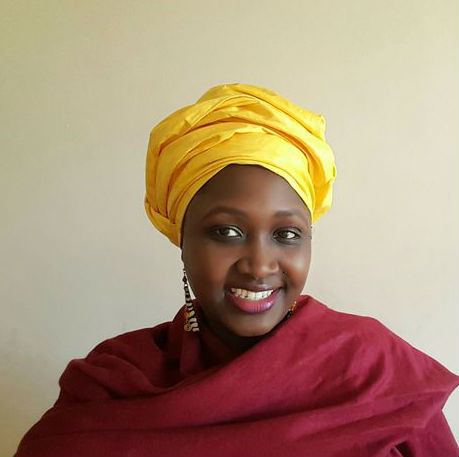
Antoinette Torres Soler left Cuba nearly two decades ago. Today, the founder of Afroféminas is using artificial intelligence to challenge the dominance of Western perspectives in technology and create a tool rooted in Black feminist thought.
by Marta Abbà/edited by Juliana da Penha
“Arriving in Spain from Cuba meant confronting, in a brutal way, a racialisation that operated differently in Cuba.” Antoinette Torres Soler is not talking only about migration policy. She is tracing the origins of an artificial intelligence shaped by that experience.. A philosopher and activist and founder of Afrofeminas, a political, cultural and technological platform since 2014 promoting the black feminist, anti-racist and decolonial thought, the 50 years old has spent nearly two decades navigating life in Europe as a Black migrant woman, in Zaragoza, Spain Those experiences would eventually lead her to create AfroféminasGPT, a groundbreaking AI model trained exclusively on the works of Black, anti-racist and decolonial thinkers. Developed without access to the internet and launched in October 2025, the project is both a technological experiment and a political intervention.
In Spain, Torres Soler encounters a racialisation that settles slowly, everywhere: at work, in the media, in silences, “in the way a Black woman was often expected to speak, stay quiet, or be grateful.” It is not an occasional experience but a persistent reality,one that follows her across contexts and institutions, rarely announcing itself directly, more often operating through what is left unsaid. Through conversations with Black women in countries as diverse as Argentina, Colombia and Germany, she comes to realise that what initially felt personal was, in fact, structural. Across different societies, histories and cultures, many were confronting the same forms of marginalisation and the same invisible limits on how much space they were permitted to occupy.
“We couldn’t find spaces where Black and racialised women could tell their own stories from their own complexity. There was representation, yes, but almost always built from the outside.”
In 2013, that awareness became action . She launched Afroféminas a platform created to amplify Black identities and connect voices across the Global North and South. “We couldn’t find spaces where Black and racialised women could tell their own stories from their own complexity”, she says. “There was representation, yes, but almost always built from the outside.” What begins as a publishing project, gradually becomes a community, a space for learning and a political intervention. But more than a decade later, she discovers that the same patterns of exclusion and erasure have found a new home; inside technologies increasingly shaping how knowledge is produced and shared.
Who does technology serve?
In May 2025, an artificial intelligence course shifts that same urgency into a new arena> technology. What Torres Soler finds there is far from a neutral landscape. The dominant language models, she realises, do not fail accidentally: “Many AI systems don’t ignore racism by accident. They were trained inside structures where white Western experience reads as universal.” She calls this mechanism “white ignorance” — a concept used by scholars to describe how dominant systems of knowledge can obscure or exclude racial realities. It’s not an absence of information, but an active structure that produces and reproduces non-knowledge. Rather than simply reflecting existing inequalities, these systems can reinforce them, wrapping bias in the language of objectivity and distributing it at scale to anyone who types a question into a chatbot.
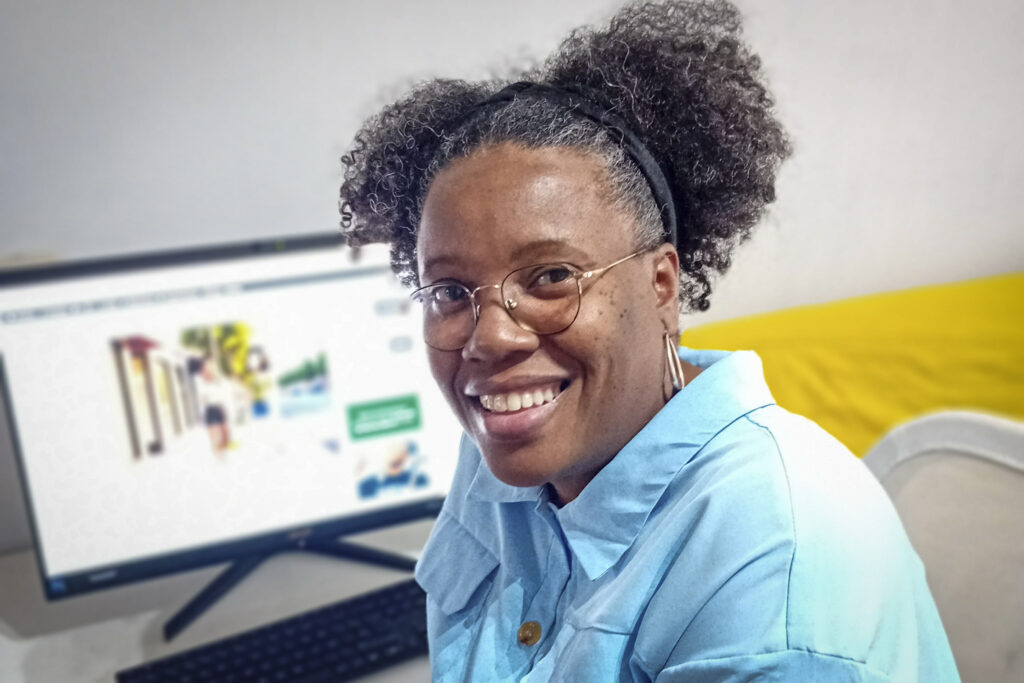
AfroféminasGPT is built as a direct political response to that structure. The model works from a carefully curated corpus by Black, feminist and decolonial thinkers, including bell hooks, Angela Davis, Frantz Fanon, Gloria Anzaldúa, Kimberlé Crenshaw, Yuderkys Espinosa Miñoso, Octavia E. Butler. Each text was selected deliberately, rather than harvested from the internet through large-scale data collection. “We chose something almost against the grain: less volume, more ethical consistency”, Torres Soler explains. The decision to stay offline is not a technical limitation. It is a political choice, designed to protect the integrity of its knowledge base by relying exclusively on a curated collection of Black, anti-racist and decolonial texts rather than the vast and often biased information available online.
“Many AI systems don’t ignore racism by accident. They were trained inside structures where white Western experience reads as universal.”
bell hooks shaped the model’s pedagogy and language “her idea of teaching as a practice of freedom runs through the entire project.” Audre Lorde l warned that: “The master’s tools will never dismantle the master’s house and inform its critical approach to technology and power.” Fanon contributed a framework for understanding the psychological dimension of colonization and the production of racialized subjectivities questions Torres Soler has confronted not only through theory, but through her own experience as a Black migrant woman in Europe. Anzaldúa, reflections on borderlands and hybridity, identity and belonging, helped shape a model designed to speak to those who live between cultures, languages and worlds, a reality that has defined Torres Soler’s own journey for nearly two decades.
The result is an AI that does not pretend to speak from nowhere. “AfroféminasGPT speaks from a situated, anti-racist and Afrofeminist position”, Torres Soler says. “That doesn’t reduce its rigor. On the contrary, it makes it more honest.” Within weeks of launch, more than 800 requests arrived, suggesting a growing appetite for alternative approaches to artificial intelligence. Built without corporate backing, AfroféminasGPT continue to run on private donations and community support.
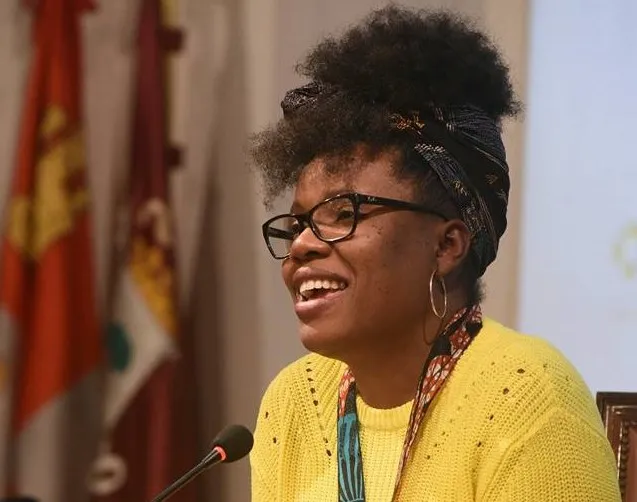
Torres Soler is also using AI for cultural production, creating short films, Afrofuturist storytelling, images of Black women “in positions of value, contexts never seen before. Nobody has done it. Nobody can tell me I’m taking something that wasn’t there.” For her technology does not replace creativity. Instead, it becomes a tool for imagining possibilities that have too often been absent from mainstream narratives, filling gaps that others never considered worth addressing.
But Torres is equally clear about the risks. The first is corporate co-optation: the language of diversity adopted on the surface while the underlying structures of data extraction and technological colonialism remain untouched. The second is political neutralisation, where concepts like intersectionality and decoloniality are stripped of their historical and political meaning and reduced to buzzwords or branding exercises. “Black thought was not born to produce institutional comfort, but for the survival and dignity of our communities.” The third concern is the rapid expansion of AI without minimal ethical accountability: In this scenario, technologies can amplify racism, misogyny and disinformation at a scale that becomes increasingly difficult to challenge or correct once the harm has already been done.
“AfroféminasGPT was not born to prove that Black women can do technology too. We already know that. It was born to ask what kind of technology we want to build to sustain life.”
In the months ahead, AfroféminasGPT aims to establish itself as a long-term resource and tool for anti-racist education, expand its corpus with voices from Latin America, the Caribbean and Africa, deliberately reducing dependence on Anglo-Saxon theoretical frameworks.
Another challenge is language itself: how to build an AI that understands racial violence in Spanish in its own terms, without automatically interpreting Black experiences through concepts and categories produced elsewhere.
Three areas of development are already taking shape: educational tools for schools and universities, Afrofuturist cultural production, and creation of community-owned technological spaces.
For all its ambition, the project starting point remains unchanged. “AfroféminasGPT was not born to prove that Black women can do technology too. We already know that. It was born to ask what kind of technology we want to build to sustain life.”
Learn more about Afroféminas and AfrofeminasGPT here
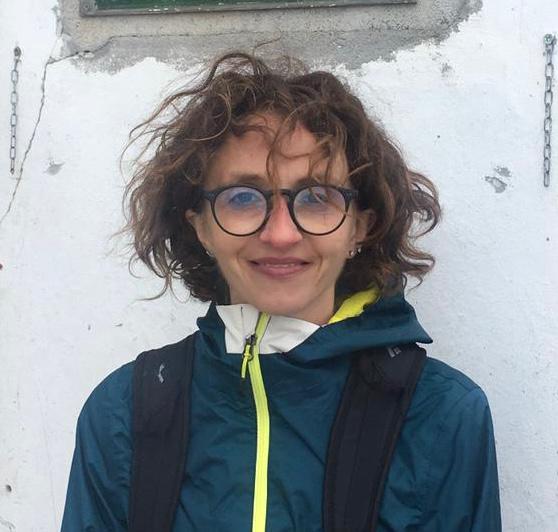
Marta Abbà is an Italian freelance investigative journalist and environmental physicist with a focus on climate and digital justice, gender and migrant rights.