
As governments prepare to assess progress at the Second International Migration Review Forum (IMRF) 2026, one truth must be confronted: The global care economy is expanding rapidly. However, it is being built on the systemic exploitation of migrant domestic workers.
by Bariyah and Sofia Trevino
Across the world, millions of women migrate to provide care. They clean homes, raise children, support older people, and sustain entire economies. Domestic workers are crucial in the care economy, they provide at least 25% of care globally. Demand for paid care work is growing rapidly, with estimates suggesting that the care economy could generate around 300 million jobs by 2035 (ILO, 2022).
Migrant domestic workers are not a marginal group in this context. They are central to how care systems function in high-income countries and beyond. Yet, while demand for care labour continues to grow, protection for workers’ rights does not. This contradiction is not accidental; it is structural.
Migration systems continue to prioritise labour supply over human rights.
Migration systems continue to prioritise labour supply over human rights. Domestic work remains undervalued and excluded from labour protections. And migrant domestic workers, particularly those in irregular situations, are systematically denied access to justice, social protection, and labour rights.
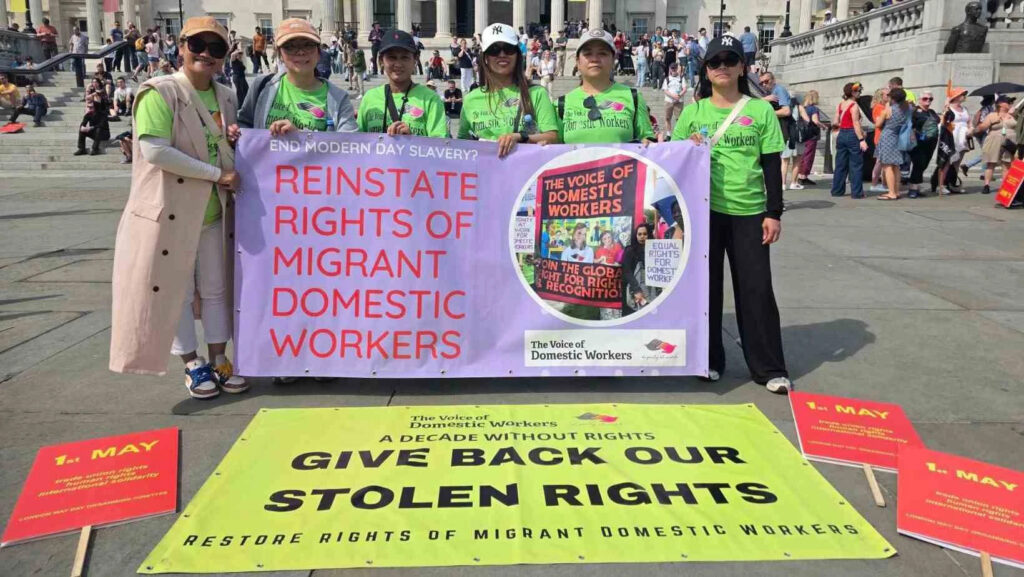
At the same time, governments are increasingly investing in national care policies and systems. Too often policies are designed without integrating labour rights frameworks such as ILO Convention 189, the first international convention directly addressing domestic workers. Without guarantees on wages and decent work conditions, care systems risk reproducing the inequalities they aim to address.
We are not facing a care crisis alone. We are facing a crisis of political will.
A system built on inequality
There are more than 75 million domestic workers globally, including over 11 million migrants – most of them are women.
They migrate not by choice, but because of economic inequality, climate change, conflict, and lack of opportunities in their countries of origin. Once they cross borders, their rights are often taken away.
There are more than 75 million domestic workers globally, including over 11 million migrants – most of them are women.
Many migrant domestic workers face excessive recruitment fees and debt bondage, long working hours without rest, physical, emotional, and sexual abuse, non-payment of wages, and restrictions on movement and the right to change employers. In regions governed by systems like kafala, workers are tied to employers in ways comparable to modern-day slavery. These are not isolated incidents, they reflect a system driven by temporary migration policies that enable and sustain exploitation.
Even in countries with legal protections, migrant domestic workers remain invisible. Many are excluded in practice and unable to claim their rights due to fear of deportation or retaliation.
This is not a gap in policy. It is a failure to enforce rights where they matter most: in the lives of domestic workers.
Progress exists, but it is not enough
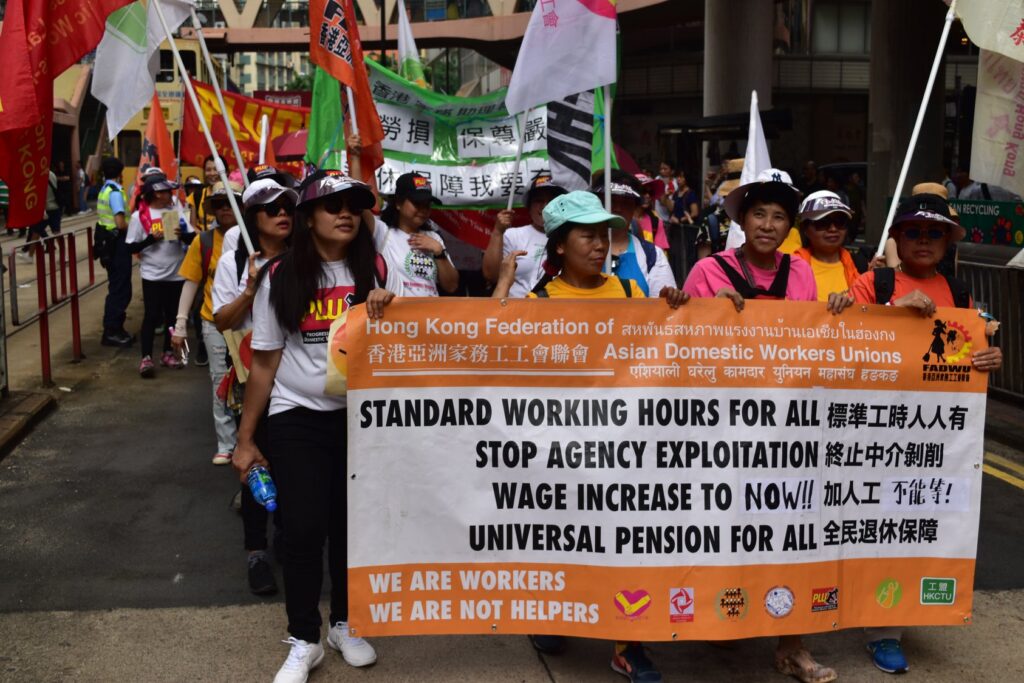
Migrant domestic workers are not passive victims of this system. They are organising, leading reforms and transforming systems. Through collective action, led by trade unions such as the International Domestic Workers Federation (IDWF), which brings together 94 affiliates across 71 countries representing over 700,000 domestic workers, workers have achieved 40 ratifications of ILO Convention 189, collective bargaining agreements, and over 83 law reforms in the last five years related to labour and social protections across Africa, the Americas and Asia. These changes are the result of decades of organizing led by women domestic workers themselves.
But progress remains uneven and fragile.
Migrant domestic workers are not passive victims of this system. They are organising, leading reforms and transforming systems.
In many countries, domestic workers are still excluded from labour laws. Informality remains extremely high –over 80% domestic workers globally– leaving millions without contracts, protections, or access to social security.
We cannot celebrate progress while ignoring the scale of exclusion that persists.
The International Migration Review Forum (IMRF) must deliver real change
The Global Compact for Migration set out a vision of safe, orderly, and regular migration. But for migrant domestic workers, this vision remains largely unfulfilled.
At the IMRF, governments must move beyond declarations and take concrete action, such as:
- Recognize domestic work as work. This means full inclusion in labour laws, equal protection, and enforcement mechanisms that reach into private households.
- Guarantee freedom of association and collective bargaining. Migrant domestic workers must be able to organize, join unions, and negotiate collectively –without fear of retaliation or deportation.
- Ensure that national care systems are anchored in ILO Convention 189. Care strategies must include migrant domestic workers in their design.
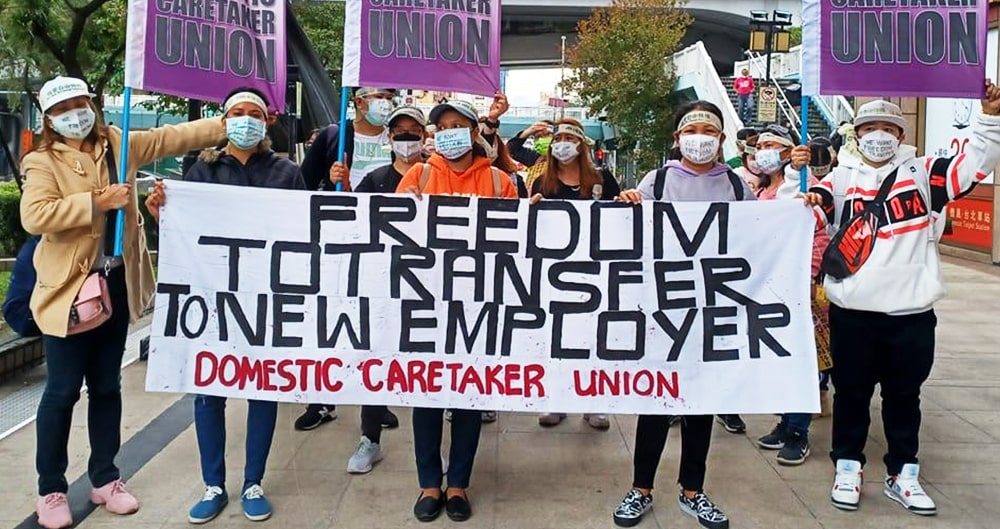
- Guarantee rights-based migration pathways. Temporary migration schemes and employer-tied visas must be replaced with systems that allow workers to change employers, access justice, and live with dignity.
- Abolish systems of control like kafala and employer-tied visas. No worker should depend on an employer for their legal status or freedom.
- Guarantee free and fair regularization program that grants all migrant workers full legal status and a clear pathway to permanent residency, ending exploitative temporary permits and precarious work conditions.
- Ensure social protection for all migrant domestic workers. Health care, pensions, and unemployment protection must be portable and accessible across borders.
- Regulate recruitment systems and enforce zero-fee policies. No worker should begin their migration journey in debt.
- Protect migrant domestic workers in crisis and conflict. Emergency evacuation, access to humanitarian protection, and safe pathways are essential.
A different future is possible
The care economy will continue to grow. The question is not whether migrant domestic workers will be part of it. They already are!
The question is whether this growth will continue to depend on exploitation. Will governments be willing to build care systems grounded on rights, dignity and justice?
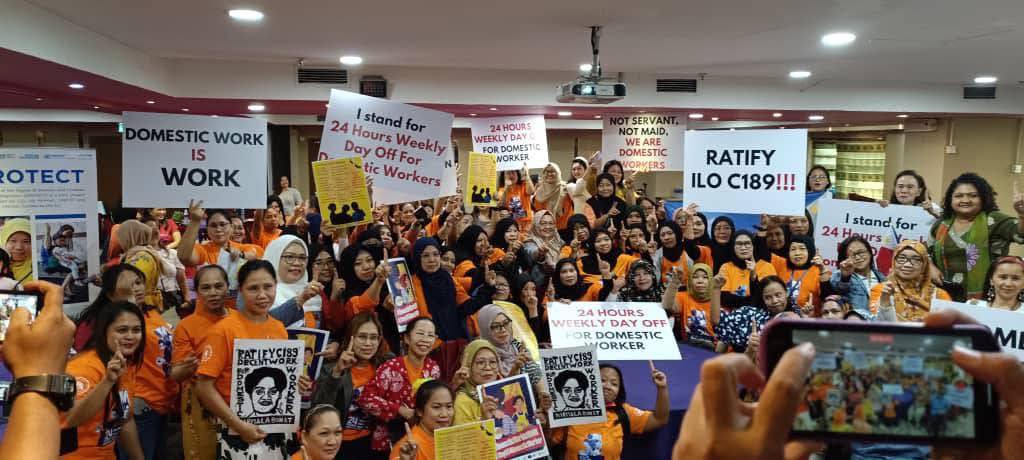
Migrant domestic workers have already shown what change looks like. They have organized across borders, built unions, influenced laws and transformed policies across the world.
At the IMRF, governments have a choice: continue managing migration as a source of disposable labour; or recognize migrant domestic workers as workers and essential economic actors.
There is no just care system without migrant domestic workers.
Learn more about the International Domestic Workers Federation here.
Read the Spotlight on Migration report produced by Women In Migration Network (WIMN) here.
Bariyah is a former migrant worker who has been advocating migrant workers rights since 2010. She currently works as an Asia Program Officer at the International Domestic Workers Federation (IDWF). Building on her lived experience as a migrant worker, she plays a vital role in organizing migrant domestic workers, providing capacity-building support, and fostering leadership development to strengthen migrant domestic workers’ voices and advance worker's rights and justice.


Sofia Trevino is the Strategy and Impact Coordinator at the International Domestic Workers Federation (IDWF), where she works with worker-led organizations to build collective power and advance the rights and recognition of domestic workers worldwide. She has supported IDWF since its inception as a network in 2008, followed by the historic adoption of ILO Convention 189 and its formal founding as a Federation in 2013. She previously worked with WIEGO, leading global efforts on strategy, communications, organizing and impact.