
The IMRF 2026 kept gender on the agenda, but feminist advocates warn that visibility alone is not progress. The real test now lies in whether governments will turn commitments into action.
by Paola Cyment
The second International Migration Review Forum (IMRF), held in New York from May 5–8, 2026, unfolded against an extraordinary convergence of crises. Escalating conflicts, deepening climate-induced displacement, mounting attacks on gender equality in multilateral spaces, and the alarming erosion of multilateralism itself shaped the political backdrop within which Member States gathered to assess eight years of implementation of the Global Compact for Safe, Orderly and Regular Migration (GCM). In this landscape, one that WIMN’s Feminist Manifesto for Structural Transformation in Migration Governance described as demanding political courage to confront exclusionary migration policies, the stakes could not have been higher for migrant women and gender-diverse people on the move.
In a moment of acute multilateral fragility, the adoption of the IMRF Progress Declaration by consensus was no small feat. Its subsequent endorsement by the UN General Assembly, with 147 votes in favor, ensured that gender-responsive language previously agreed in the GCM and in the 2022 Progress Declaration was preserved. But feminist accountability demands we also recognise this for what it was: not a step forward. Preserving what already existed is a floor, not a ceiling. It is in the gap between what was agreed and what is still needed that this analysis begins.
Inside a divided Room: the Politics of Gender Language
The Informal Gender Network, convened in coordination with the UN Network on Migration, UN Women, OHCHR, UNDESA, WIMN, the Gender + Migration Hub, the International Detention Coalition, and the IMRF Gender Rapporteur— was instrumental in advancing gender language from the zero draft to the final Progress Declaration. Bringing together more than 20 governmental delegations alongside civil society and UN partners, the Network demonstrated the value of sustained, informal coordination in a high-stakes negotiating environment. Yet it also surfaced a fault line at the heart of the GCM: between those governments that prioritized deterrence frameworks, reinforced the regular/irregular binary, and centered State sovereignty in their approach to gender language; and those that consistently advocated for rights-based, expanded regular pathways, and stronger protections for all migrants regardless of status. The divide was not always cleanly geographical or ideological. Several governments that supported gender-responsive language at the Forum continued to pursue migration deterrence policies that undermine the rights and autonomy of migrant women in practice.
Several governments that supported gender-responsive language at the Forum continued to pursue migration deterrence policies that undermine the rights and autonomy of migrant women in practice.
At the same time, a small number of delegations arrived with explicit anti-gender objectives, seeking to replace “gender-responsive” with the weaker formulation “gender-sensitive,” and to excise references to “multiple intersecting forms of discrimination” from the final text. They did not prevail. The preservation of intersectional language represents a hard-won, collective achievement — one that must be acknowledged as such. But the sustained energy required simply to defend already agreed language left little political space to advance the transformative commitments that migrant women and gender-diverse people are still waiting for.

Externalization — the offshoring of migration control and asylum processing to third countries — emerged as one of the most contested issues of the week. Some countries from the Global South pushed for explicit language condemning these arrangements in the Progress Declaration, arguing they shift the burden of migration management onto lower-income states while shielding wealthier nations from their human rights obligations. That paragraph did not survive the negotiations. Its absence is not a neutral outcome: it reflects the continued capacity of powerful destination states to protect their deterrence architectures from multilateral scrutiny, even within a framework nominally committed to shared responsibility.
The route-based approach — framing migration governance around specific geographic corridors — featured prominently in the formal debates. Civil society organizations raised serious concerns that this framing, without robust rights-based safeguards, risks normalizing forced returns and expanding externalization measures along migration corridors.
Visible, But Not Transformative
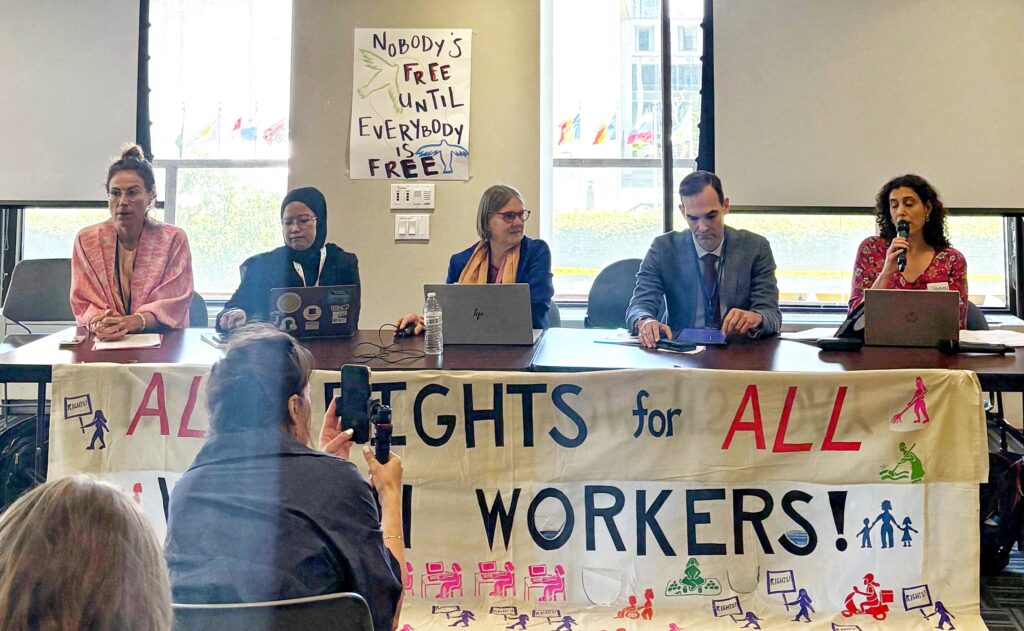
Gender was highly visible at the IMRF— mainly in side events and in civil society interventions. The care economy emerged as a central theme, with the powerful side event “Towards a migration governance with care perspective” co-organized by WIMN and partners driving substantive discussions on recognizing, reducing, redistributing, rewarding, and representing care work. Mexico and El Salvador proposed a dedicated paragraph on the care economy in the Progress Declaration but it did not survive the final negotiations.
According to the IMRF Gender Rapporteur’s report, migrant women were consistently positioned as passive objects of protection rather than as rights holders, workers, or agents of their own lives.
Inside official sessions, the IMRF Gender Rapporteur’s analysis identified 198 gender-related references across formal proceedings — yet quantity did not translate into quality. The dominant frame remained overwhelmingly one of victimization: 75% of GCM national review reports included references to violence-related issues, confirming that gender continues to be approached predominantly through lenses of vulnerability, protection, and victimhood rather than rights and agency. Human trafficking ranked among the top gender-related concerns raised during the formal programme of work, where — in stark contrast to the multi-stakeholder process — the focus gravitated toward trafficking, vulnerability narratives, and governance themes. According to the IMRF Gender Rapporteur’s report, migrant women were consistently positioned as passive objects of protection rather than as rights holders, workers, or agents of their own lives. More transformative dimensions of gender-responsive migration governance — including women’s agency, participation in decision-making, care work, and labor pathways — were raised far more often by civil society and UN entities than by Member States. As the report concludes, gender equality may be acknowledged as a GCM guiding principle, but it is not yet consistently operationalized across migration governance frameworks, implementation, or reporting systems.
There is also a persistent conflation that feminist advocates must challenge: the grouping of women and children as a single, undifferentiated category. The Progress Declaration and many Member State interventions defaulted to “women and children” as if they constituted a unified group with identical needs. This conflation reproduces a deeply patriarchal construction of migrant women primarily as mothers, caregivers, and protectors of children, rather than as autonomous individuals with distinct rights, labor interests, and political subjectivity. When women appear in policy texts only in relation to children, their identity is reduced to their reproductive and caregiving roles — echoing the same logic that confines them to the lowest-paid, least-protected sectors of the care economy in destination countries. Migrant women are rights holders under CEDAW; children are rights holders under the CRC, with protections calibrated to their distinct developmental needs. These are different legal subjects, with distinct frameworks, vulnerabilities, and claims on States. Collapsing them into a single category does not protect either group more effectively.Instead it infantilizes women, naturalizes their subordination as caregivers, and obscures the structural conditions that make migrant women disproportionately responsible for both paid and unpaid care work across borders.
The Gap Between Words and Action
The structural challenge now lies at the country level. According to the UN Network on Migration’s analysis of 89 national voluntary GCM reviews and 8 regional reviews, only 48% made explicit reference to gender responsiveness,making it the least reported GCM guiding principle of the entire framework. That is a stark measure of how far implementation still lags behind commitment. Countries are developing migration policies without evidence-based data disaggregated by sex or gender and without consulting migrant women-led organizations. National Implementation Plans remain the key tool to bridge this gap—and they remain largely gender-inequitable. This is precisely where WIMN’s Feminist Migration Policy Agenda (FMPA) becomes essential: as both analytical and advocacy framework to push governments beyond declaratory commitments toward gender-responsive and ultimately gender-transformative implementation.
In the next phase of implementation, WIMN will advance this agenda alongside the Spotlight Report on Global Migration 2026, developed with Friedrich-Ebert-Stiftung, which offers concrete recommendations on regular pathways, care, climate displacement, regularization, criminalization, and digital surveillance, all grounded in an intersectional feminist lens.
Migrant Women’s Leadership Cannot Be Optional
At the IMRF, migrant women leader Natividad Obeso spoke powerfully as the migrant voice in official proceedings,a moment of representation that matters. But visibility in a UN session, while necessary, is not participation in governance. The real challenge is ensuring that migrant women-led organizations actively participate in the design, implementation, and monitoring of migration policies at the global, regional and national level—not as consultees to be heard once and set aside, but as architects, decision-makers and accountability-holders of the systems that govern their lives.
As the Feminist Manifesto demands, “true gender-responsiveness requires the full, equal, safe and meaningful participation of migrant women and gender-diverse people in all policy spaces that impact their lives, avoiding tokenism.”
As the Feminist Manifesto demands, “true gender-responsiveness requires the full, equal, safe and meaningful participation of migrant women and gender-diverse people in all policy spaces that impact their lives, avoiding tokenism.” That vision endorsed by more than 140 organizations worldwide. Its demands for rights-based alternatives out of irregularity, for recognition of care work as skilled labor, for strict firewalls between services and immigration enforcement, for climate pathways, for an end to digital bordering, remain the unfinished business of global migration governance.
The Work Ahead
The IMRF 2026 delivered a Progress Declaration that was politically possible, not politically transformative. Gender was visible throughout the week—in negotiations, in side events, in civil society interventions—but visibility without implementation on the ground is not real progress. Though the majority of Member States expressed their commitment to the gender-responsive guiding principle, the question is whether they are prepared for what that means in practice, at the national level, in policy design and budget allocation. That is the work ahead. WIMN will pursue it through the Feminist Migration Policy Agenda (FMPA) and the Spotlight Report on Global Migration 2026—two frameworks built precisely for this moment: translating global commitments into national implementation, and keeping migrant women’s rights, agency, and leadership at the center of every policy conversation that follows.

Paola Cyment is Advocacy Lead at the Women in Migration Network (WIMN). She is an expert in migration, gender, human rights and development. Paola has held various positions in national and international NGOs, working on research, advocacy, institutional development, and project management. She has extensive experience in negotiation and dialogue with high-level authorities (national, regional, and international) in international migration governance spaces. In recent years, she has focused on gender and migration issues as part of the Secretariat of the WIMN.
The Women in Migration Network (WIMN) is a global feminist network advocating for the rights, agency, and leadership of migrant women and gender-diverse people in global migration governance. Find out more at www.womeninmigration
Read “Towards the IMRF: A Feminist Manifesto for Structural Transformation in Migration Governance”