With grown-up children busy with their own lives and traditional family dynamics evolving, many Muslim women over 50 are experiencing declining mental wellbeing due to isolation. In Lanarkshire mosque, one group is helping to rewrite that story.
by Sana Faqir
It’s not unusual when children get together for a fun-filled day, for them to be so excited about seeing their friends that settling them down becomes a challenge. Too busy chatting, they barely hear the teacher the first time she asks for quiet. There is a similar air of festivity within the Pearl Group on this rainy December Wednesday, except that the ‘classroom’ is filled with women in their 50s and beyond, and the ‘teachers’ are volunteers from Lanarkshire Mosque, Scotland.
The volunteers ask the group to quieten down, but the chatter continues. They exchange a knowing smile with one another, then go for a firmer approach, this time by tapping the table. Slowly, the women settle, and together, they all recite the beautiful names of Allah.
The Pearl Group began in March 2023 as a means of giving this generation of Muslim women (over 50s) a social activity away from their home routines. This age group of women, mostly immigrants to Scotland from Pakistan, India and Bangladesh, spent their younger years complying with the cultural expectations placed upon them. They supported their husbands, both by running the household and putting in shifts at the family convenience store. They looked after, or simply entertained, ageing in-laws who lived with them. All this on top of the day job: raising their children in an environment that was alien to them.
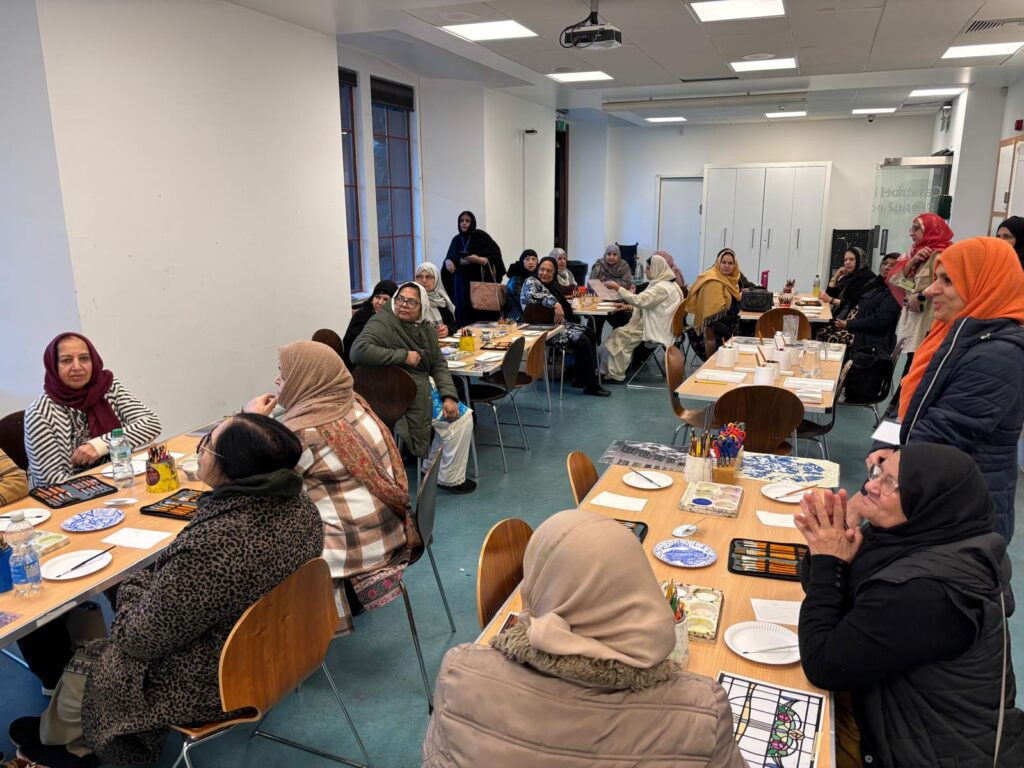
Women together at Pearl Group activity. Photo by Sana Faqir
They left behind their own families and childhood friends and did not speak the language of the country in which they now lived. There was far too much to do to worry about building new friendships, and even the language they learned was restricted to necessity: doctor’s appointments, parents’ evenings or customers at the shop. There was simply no time to dwell on feelings or think about their own needs and desires.
The trouble is that for many of these women, once the children grew up, they truly flew the nest. Children born and brought up in the UK are no longer adhering to the old societal rules of putting wider family obligations ahead of their own needs and wants. It is the age of maintaining respectful boundaries. Many don’t live with their parents, and those who do, aren’t worrying about whether or not their parents are sufficiently entertained. They are still available for their parents, but not to the same extent as the previous generation.
The deep loneliness that sets in once your life purpose feels complete, but you have so much more to give, can only be understood by those who have lived it.
What ensued from this cultural shift was a large group of women who, until now, had never felt the need, or had the time, to make friendships, take up new activities or do things just for themselves, suddenly finding themselves with very little to do. Yet they also belong to a generation that believes a woman shouldn’t leave the house without a valid reason. The deep loneliness that sets in once your life purpose feels complete, but you have so much more to give, can only be understood by those who have lived it. This quiet crisis has not gone entirely unnoticed. A 2022 study found that one of the key requirements for providing equitable mental health care to underserved ethnic minority communities is a model of support that recognises and responds to people’s lived experiences.
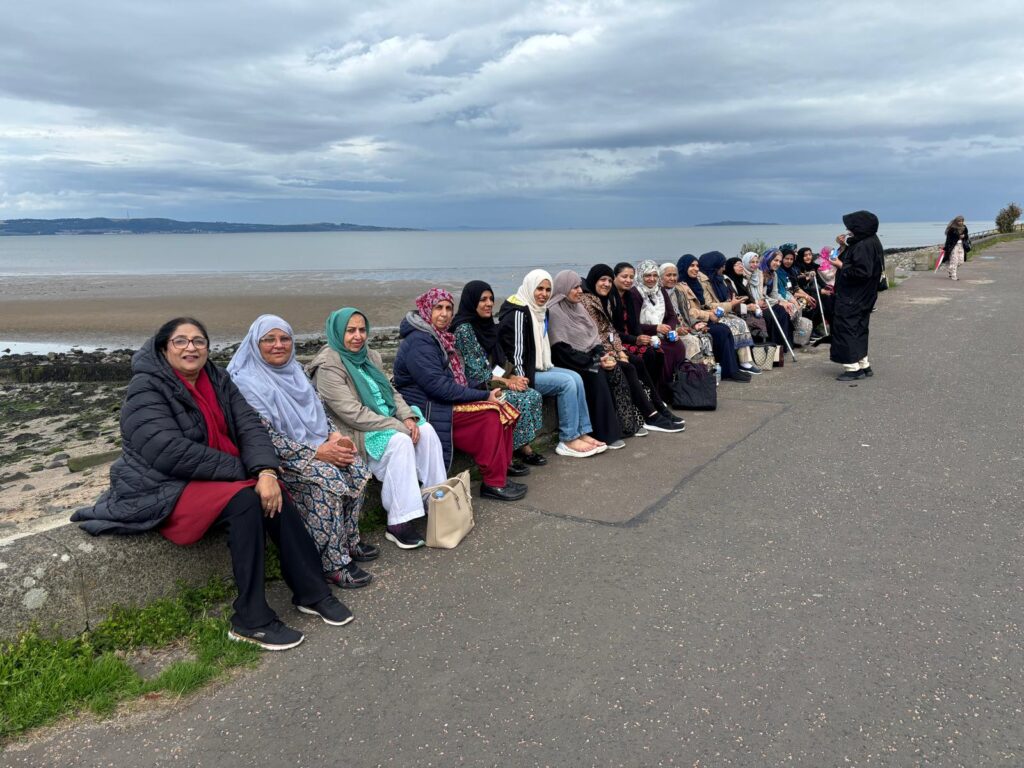
Pearl Group women at an outdoor activity. Photo by Sana Faqir.
How Pearl Group Started
“There was an NHS worker who reached out to us,” Maleeha Zeeshan, organiser of the Pearl Group, tells me. “They said they were often coming across women from our community who were severely depressed, and the root of it seemed to be that they had nowhere to go and nothing to do. Although the NHS offered several community options, there was a reluctance to join them. The suggestion was that perhaps these women would feel more comfortable in a space that was familiar to them”
This recognition that mainstream services were failing to reach older Muslim women became the catalyst for what would eventually become the Pearl Group.
“When my dad died, I tried so hard to get my mum out of the house. She kept worrying about what people would say if they saw her out and about, as though she wasn’t sad about her husband’s passing anymore. Going to the mosque was the one thing that she didn’t dispute- maybe because no matter what activity she would be taking part in, there would be an element of Islamic worship involved,” says Soubia Waseem, co-organiser.
When you are in the company of a lot of women going through so many things, you’re learning from them as well
Many of the women who joined the Pearl Group initially came with this same sense of comfort. But today, it stands as so much more than a trip to the mosque. Through the Pearl Group, these ladies have built real, life-long connections with each other.
Kulsoom Iqbal from Coltness told me, “During Covid, my husband had a stroke. I had to stay at home. The children have their own places and of course they’ve got their work. It was actually my son who said: ‘you need to come here’. I don’t drive, so he picks me up and drops me off. That’s the only time I get out unless they take me shopping. When you are in the company of a lot of women going through so many things, you’re learning from them as well… then you realise you’re not alone.”
This theme of no longer feeling so lonely came up again and again as I sat with various women, many of whom I’ve known since my own childhood. This is a generation that finds the concept of mental health taboo. Directing them to regular counselling sessions or mindfulness activities simply wouldn’t have worked, because it’s not something they felt they needed. But coming here for what they believed would be worship, alongside the opportunity to do something new, has given them the safe space they need to begin opening up to one another about their struggles.
“We talk so much when we come here. At home, we don’t have time — husbands and kids are busy with their own lives. It’s very important for us ladies to have this time with each other. We feel so relaxed when we come here. I just came back from a six-week trip to Pakistan and came straight here because I missed it so much. My husband was laughing because I was complaining about how tired I was, but I didn’t want to miss the class because it’s the last one before the winter break,” laughs Naz Parveen from Carfin.
What makes the Pearl Group successful?
When asked why they prefer the Pearl Group to non-Muslim spaces, the women tell me that the shared language, similar backgrounds and, most importantly, the food are what make the group what it is. They want to be in a place where they can feel comfortable in their own skin, after a lifetime of trying to fit into a different culture.
Each session is meticulously planned by the organisers, and the ladies are encouraged to try new things — from yoga and crafting to creating memory boxes — before sharing a meal together. The meal is the highlight, as confirmed by both volunteers and attendees, and I can see why. A steaming hot plate of pilau and lamb korma, along with various starters and sides is served up to each table. The smell and taste is sublime and takes me back to my own childhood. The ladies happily tuck in and once again, the chatter fills the air as they catch up with friends, swap stories about grandchildren, or compare blood pressure tablets.
Although the meal is the highlight, the activities add real value to the overall experience.
“I really like that we have every type of activity. They take us on trips, we even do exercise, and the girls look after us so much; Allah gives them happiness,” Samina Shauq from Carfin tells me.
The amount of organisation and effort that goes into running the group cannot be understated. Volunteers arrive early to set up, making the space welcoming with table covers and centrepieces, while others prepare food at home and bring it piping hot in time for the meal. All the volunteers then get stuck in for service, each task carried out with care and a smile.
“It’s been an evolving programme, as we never had any experience running a group like this before. We tried some things that didn’t work, but there have been far more successes than failures. It’s so lovely to see them trying something new and enjoying it, like painting. They kept saying, ‘you’re taking us back to our childhood’. We volunteers have gained so much from this experience — it just humbles you,” Soubia Waseem tells me.
“They give us so many duas (prayers), and I can’t even explain how much richer my own life has become through their prayers and being involved with this group,” Maleeha Zeeshan adds, with Soubia firmly agreeing, both becoming emotional.
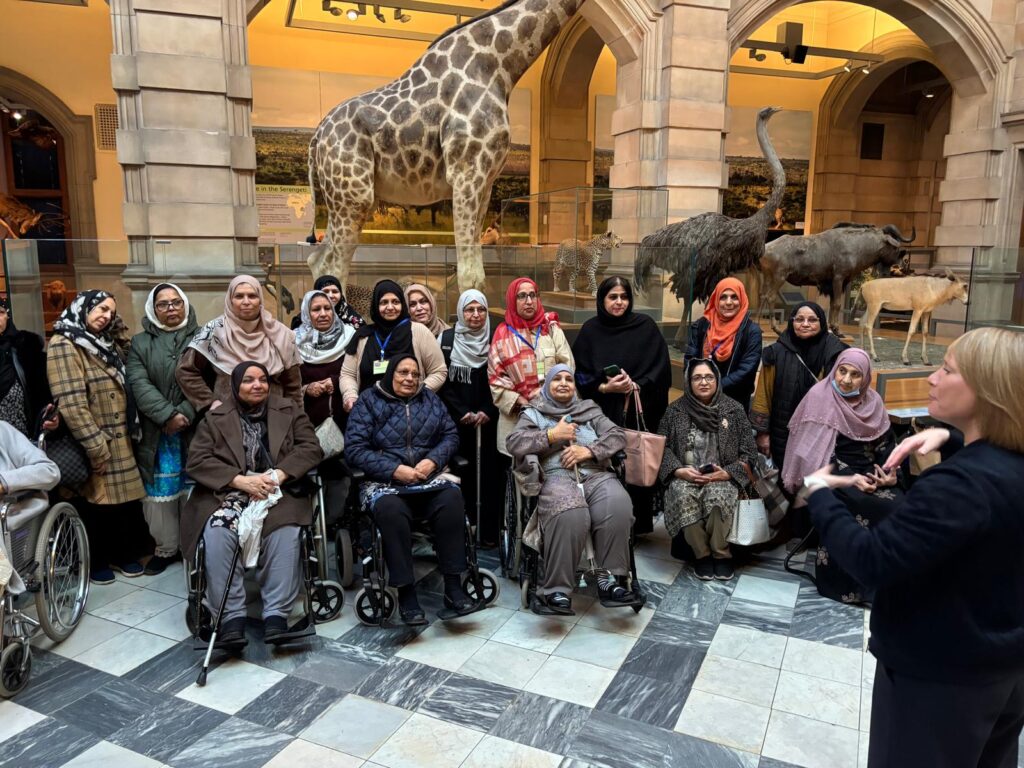
Pearl Group women on a group museum visit. Photo by Sana Faqir.
That, to me, is the essence of why the Pearl Group has grown so quickly. In just over two years, they are now operating at full capacity with 55 registered attendees and a waiting list in tow. These are women who entered marriage and responsibility at a young age, never being afforded the time or space to explore what they enjoyed or needed. They came from a culture where feelings were often suppressed, and into a society that felt foreign and unyielding. What sustained them through those years was their faith.
Set within the mosque, beginning in the name of Allah and ending in duas (prayers), the Pearl Group is rooted in that faith. By paying close attention to the cultural nuances of this generation, the volunteers understood that an Islamic foundation was the bridge needed to allow these women to try new things, reconnect with themselves and, crucially, begin talking about their mental health.
The volunteers’ dream is for this work to be replicated across the country and continued for future generations, becoming a ‘sadaqah jariah’ (ongoing charity) for those who took that first step. Maleeha and Soubia end with the following advice: “For anyone who wants to start something similar, we’d say have a good intention and just start. You don’t need a lot of funding, just people willing to put in the time to learn what these women need.”
This article was produced as part of the Migrant Women Press Fellowship Programme 2025.
Learn more about Pearl Group here.
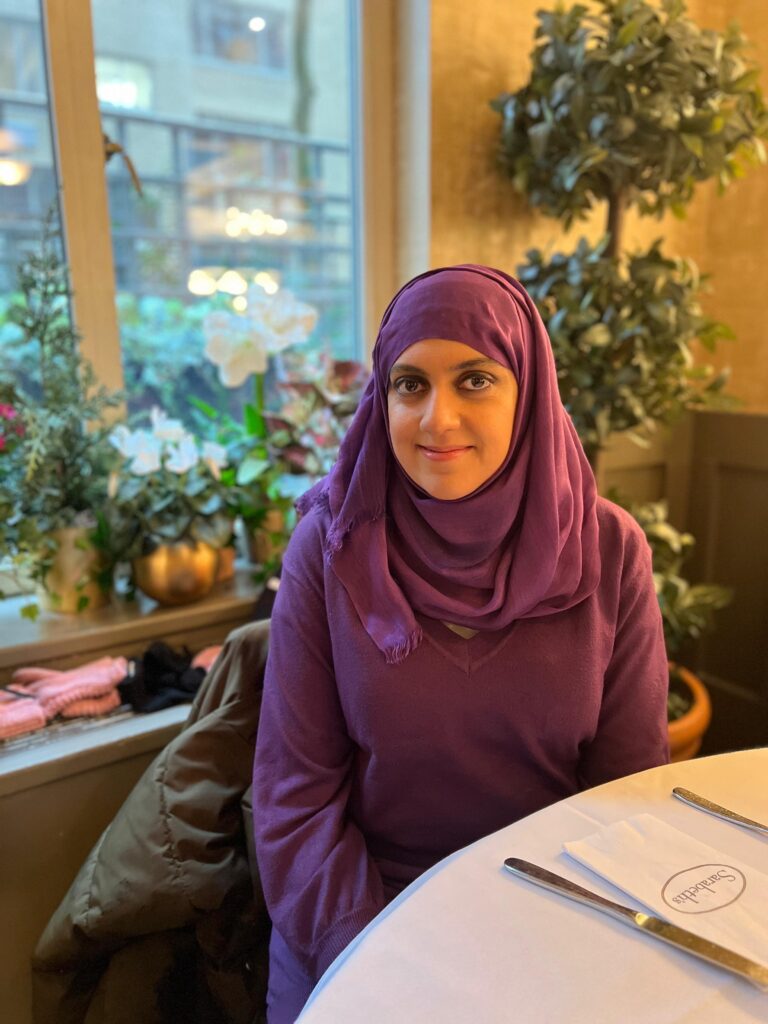
Sana A. Faqir is a Scottish Pakistani writer whose work focuses on identity, belonging, and the lived experiences of Muslim and South Asian women in Scotland. Through both her nonfiction and fiction work, Sana aims to make Muslim women of all ages feel seen. Learn more about Sana’s work through her Instagram.