From everyday harassment to institutional exclusion, Islamophobia continues to impact the lives of Muslims and perceived Muslims in Scotland. This piece explores how these patterns operate and how organisations can dismantle them.
by Eeman Talha
There is an unmistakable obsession with discussing migration and asylum in the UK. Successive governments have pushed it to the top of the national agenda, presenting it as a crisis that must be “controlled” or “stopped.”
- Refugees formless than 1% of the UK’s population.
- A total of 111,084 people claimed asylum in the UK in the year ending June 2025 – 0.16% of the total UK population.
- Public spending on the asylum system in 2024 was £4 billion, roughly0.4 % of the over £1 trillion of national spending.
Despite this, public debate has been dominated by anti – immigration sentiment. Within the last year, far-right rallies have been emboldened by populist politicians, Muslim majority neighbourhoods were declared as ‘no-go’ zones, “stop the boats” chants led nationwide attacks on asylum seekers in hotels and Saltire flags hung as intimidation across Scotland.
What is often missing from this conversation is the thread that ties these incidents together: Islamophobia is woven into each of them, but it is hardly ever identified as such.
What is Islamophobia?
In 2018, a widely adopted definition of Islamophobia in the UK was created by the All-Party Parliamentary Group on British Muslims:
‘Islamophobia is rooted in racism and is a type of racism that targets expressions of Muslimness or perceived Muslimness’.
This may leave us with more questions than answers – How is Islamophobia a type of racism? Who are perceived Muslims? What are expressions of Muslimness?
How is Islamophobia a type of racism?
It may seem counterintuitive to describe Islamophobia as a form of racism, because Muslims are a faith group rather than a racial group. However, Islamophobia is not driven by views about Islam itself. It is rooted in racialised assumptions about who Muslims are, how they look, and where they come from.
Islamophobia relies on stereotypes that treat Muslims as a homogenous group linked to particular ethnicities, regions, or forms of dress. These assumptions treat “Muslimness” as if it is a fixed racial characteristic rather than a matter of personal belief. As a result, Islamophobia functions as racism: it targets Muslims and those perceived to be Muslim, transforming them into “racialised others.”
This is why individuals from other religious or ethnic backgrounds are frequently subjected to Islamophobia. Documented cases include women and men from Sikh, Hindu, Christian and atheist backgrounds, Black men with beards, and Central or Eastern European migrant men in the UK — all targeted because they were perceived to “look Muslim”.
Fatma, a member of our JustCitizens panel, captures this poignantly:
“Removing my hijab or niqab is not a solution. The problem is not just for visible Muslims – it is for every woman who looks like a migrant, or every man with a beard. It is for everyone who is not white.”
Her words underline a crucial point: Islamophobia extends beyond religion. It actively targets anyone who does not fit the imagined profile of “Britishness”.
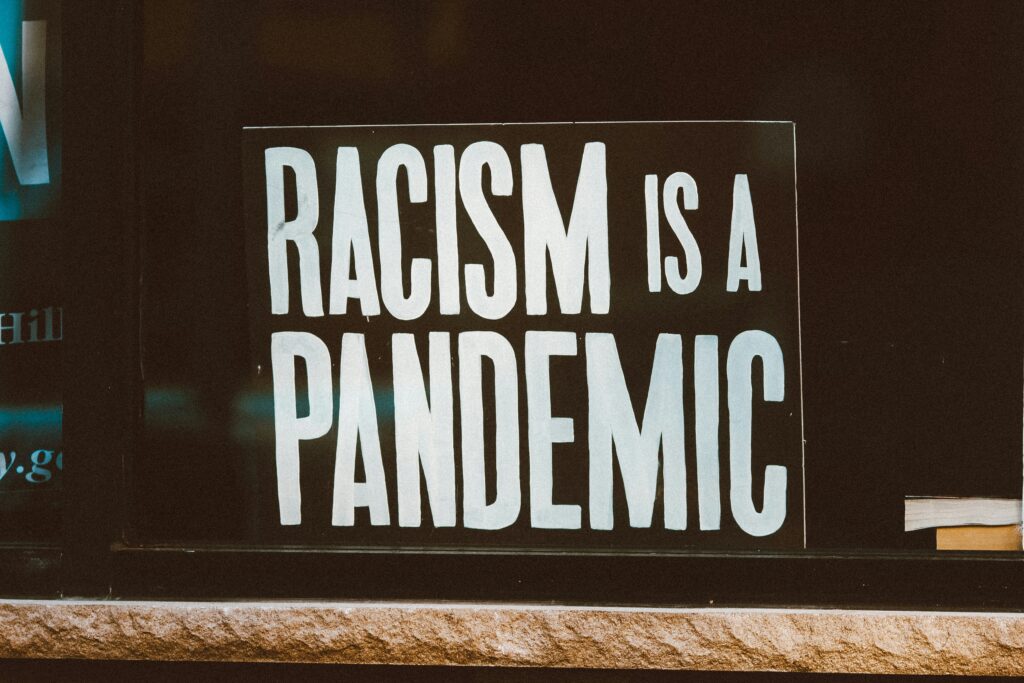
What constitutes Islamophobia?
Islamophobia is not a single type of behaviour. At its core, it works by excluding or limiting Muslims — and people perceived to be Muslim — from participating fully, safely, and confidently in everyday life. This materialises in different ways. For Muslim migrant groups, the most common forms of Islamophobia can look like the following:
Everyday Islamophobia refers to common, normalised behaviours that stigmatise or intimidate Muslims. While some may be hate crimes, many are not illegal but are still harmful: being stared at or glared at in public, hearing degrading comments or slurs, experiencing social exclusion and the denial of the right to participate, facing online abuse, and being subjected to suspicion or intrusive questioning in public spaces.
Structural or Institutional Islamophobia includes systematic policies – especially within security, policing, and state-monitoring systems, as well as within certain education, employment, and immigration practices – that disproportionately affect Muslim communities and reinforce perceptions of them as ‘outsiders’.
While no UK law specifically names Islamophobia, hate crimes against Muslims are prosecuted under broader legislation. These include verbal abuse, threats, physical attacks, or property damage motivated by anti-Muslim prejudice.
In Scotland, Islamophobia is on the rise and only 22% of Islamophobia victims report incidents to the police. In almost all cases, their complaints are dismissed. Fatma’s experience highlights this: of the four serious hate crimes she experienced that she reported with evidence, only one was investigated by Police Scotland and which led to a conviction.
Under-reporting damages trust in authorities and leaves wider ethnic or social groups feeling unprotected and disregarded by the state.
How is Islamophobia weaponised by the Far-Right?
In the context of rising hostility – evident in the August 2024 unrest, the far-right rally in September 2025, and the wave of rallies outside asylum-seeker hotels across the UK, it is vital to recognise how the forms of Islamophobia above shape the narratives that lead to these events.
Normalised Islamophobia in the government and media has contributed to anti-immigration rhetoric. Before the riots took place, former Home Secretary Suella Braverman claimed that “the Islamists, the extremists and the PC brigade are in charge now”. Before the far-right rally in September 2025, Nigel Farage promised that the Reform party would carry out mass deportations of small boat arrivals because, “we have a massive crisis in Britain”.
These comments lay the groundwork for exclusionary politics, which feeds the idea that Muslim and migrant communities are dangerous, and incompatible with public life. It creates conditions in which individuals feel emboldened to engage in political violence and believe they can act with impunity.
The impact of the rallies outside asylum hotels have deeply traumatised those accommodated therein – of which most people housed come from Muslim-majority countries. Government data shows that the majority of asylum seekers arriving through so-called “irregular routes” are from countries like Afghanistan, Ethiopia, Eritrea, Iran, Iraq, Syria and Sudan. We can understand anti-migrant policies then, not merely as anti-migrant, but also as anti-Muslim.
This is especially clear from the experience of those supported by Tomás Pizarro-Escuti , a Rights Reps Project Officer and Caseworker at the Grampian Regional Equality Council. He described:
“In recent months, North-East Scotland has experienced a surge in far-right activity and hate crime. Their main target? Immigrants, but especially those who are Muslims. The abuse ranges from harassment on the way to the mosque for Isha and Fajr prayers, to having racial slurs and accusations of paedophilia broadcast over sound systems to amplify the hatred. It has even escalated to death threats and people being stoned…”
What does this mean for those who support migrant groups?
For Muslims in Scotland, Islamophobia is not rare or isolated. 75% of Muslims say they experience Islamophobia regularly.
Recognising how Islamophobia works helps us see the layers of prejudice clients face. Many of the migrant groups we support at JustRight Scotland – particularly asylum seekers, refugees, victims of trafficking, victims/survivors of domestic violence – are navigating experiences of being demonised and blamed for the State’s failures, whilst facing the challenge of integration, physical, mental and financial insecurity, isolation and re-traumatisation from a hostile immigration system.
Understanding this also helps us tackle the notion of Scottish exceptionalism. Believing that Scotland is free or not as impacted from the systemic racism that exists in the rest of the UK, reinforces the stigma that denies Muslims and perceived Muslims of the everyday, structural and overt forms of Islamophobia that they experience. Once we recognise that the same racist system that oppresses migrants also oppresses Muslims and racialised communities, we create space for proactive advocacy and focused action that realises the inclusivity that Scotland promises the communities it supports.
If we, as organisations, are to say we are anti-racist, then this means more than opposing overt hate. We must recognise and understand Islamophobia as racism, and commit to learning how it operates across society and how it harms Muslims and those perceived to be Muslim, including migrants and refugees. This can begin with conversations of what everyday Islamophobia is.
Another important step is name discrimination when we see it and challenge far-right narratives that distort public understanding of migration and ensure we actively support and include Muslim voices. See the free Islamophobia Awareness Training offered by IAM here.
Once we recognise that the same racist system that oppresses migrants also oppresses Muslims and racialised communities, we create space for proactive advocacy and focused action that realises the inclusivity that Scotland promises the communities it supports.
We should also actively challenge the systems and assumptions that allow racism to continue and resist Islamophobic rhetoric. MEND (Muslim Engagement & Development) have produced a useful resource to inform ourselves of how systemic Islamophobia is in Scotland, here.
When speaking with Fatma, what became clear was that despite the threats she has faced to her identity, this did not waiver her sense of belonging to Scotland. This is true for most British Muslims, who report a stronger sense of British identity than the wider public: 55% say their national identity is important to them, compared with 44% of the general population.
“I don’t think the groups who hate me will ever realise what being Scottish means to me – it is power, solidarity, community and pride. I chose to come here, many don’t. But we all wish to call somewhere home. Especially when we are starting again, after having lost all that we considered dear to us.
I choose to fight the narrative against us because I feel empowered doing something to relieve the burden for my community, because it won’t only impact us, but it will impact the country, and the morals and values that will shape future communities. That is what being Scottish is, to know I am creating a life that empowers me, and for those that come after me who can have this same privilege – to build their own pride of being Scottish.”
Eeman Talha is a Senior Legal Caseworker at the Scottish Anti-Trafficking and Exploitation Centre and the Scottish Refugee and Migrant Centre at JustRight Scotland. She holds an LLB in Scots Law, an LLM in Human Rights Law and a Diploma in Professional Legal Practice. She is a published author who has focused her research on minority rights, notably those related to religious and ethnic minorities within Europe and South Asia who are subject to persecution and discrimination.
Learn more about Just Right Scotland here