For 20 days, journalist Marta Abbà lived on a civilian rescue vessel in the central Mediterranean, documenting the realities faced by people pulled from the sea, centering the experiences of women whose journeys, vulnerabilities, and resilience remain too often unseen.
by Marta Abbà
The walls are painted with colorful trees and spirals stretching in no clear direction, as if trying to open a path where none exists. The colors are bright, almost childlike, sharply contrasting with the rest of the ship: metal surfaces, the smell of fuel, functional spaces. Here, instead, there are bunk beds arranged in a horseshoe shape, a small shelf with children’s books, and changing table.
“We try to offer a safe space, a place where women can begin to express what they have carried for a long time.”
Next door, behind a narrow door, a storage room holds toys and markers.
The shelter for women and children on the Humanity 1 — a civilian rescue vessel operated by the humanitarian organisation SOS Humanity in the central Mediterranean — is located on the lower deck, next to large dispensers where hot, heavily sweetened tea is served.
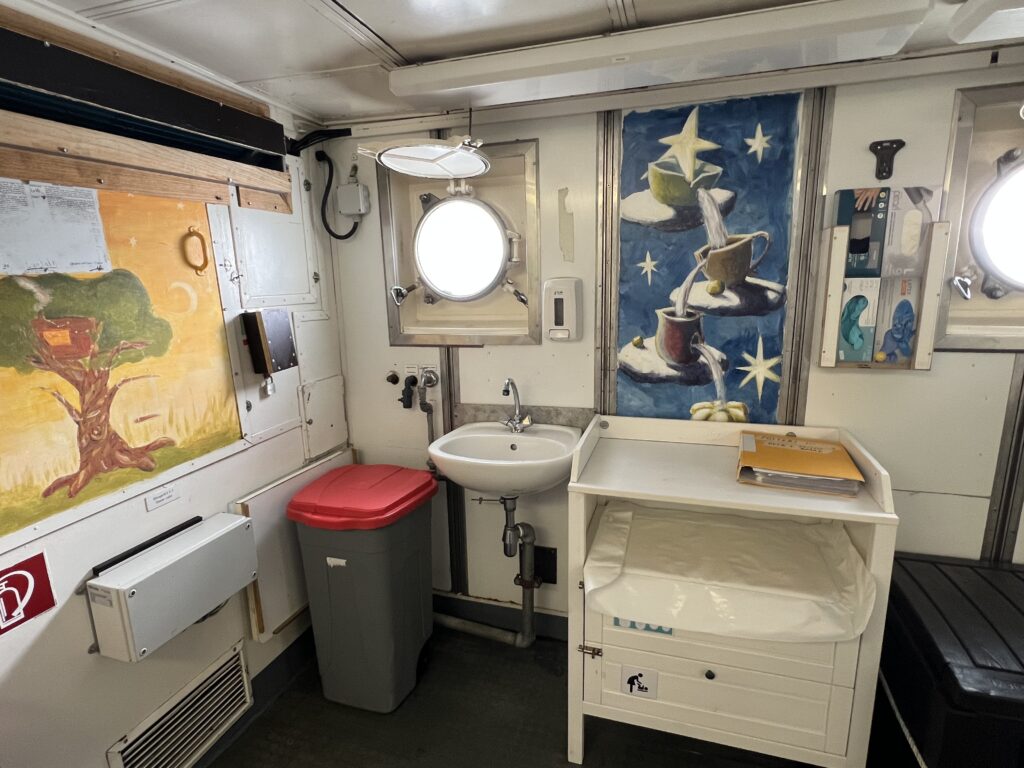
One of the two areas designated for female and child survivors.Photo by Marta Abbà
It is one of the first gestures after rescue: a sugary drink, immediate energy, something warm as the body readjusts to solid ground or rather, to the relative stability of a ship.
Women arrive here still wrapped in thermal blankets. Some sit down immediately, while others remain standing, as if stopping were premature. Children move first, drawn to the colors, the objects. The women observe. It is a space designed to lower tension, though it does not remove it. It contains it.
“It is not a shelter in the full sense of the word. It is a structured pause.”
“We try to offer a safe space,” explains Frances, the onboard care coordinator. “A place where women can feel safe enough to ask questions and begin to express doubts and things they have contained inside them for a long time.”
It is not a shelter in the full sense of the word. It is a structured pause.
Outside the shelter, the work follows a precise logic. The Humanity 1, a rescue vessel operated by SOS Humanity, is designed to intervene quickly and manage the immediate aftermath of a rescue.
Frances coordinates the care team: a doctor, a nurse or paramedic, a midwife, a mental health specialist, a protection officer, and a cultural mediator. “The goal is to have an overall picture of each survivor’s condition in order to meet their needs as best as we can,” she says. “Every mission is different. We never know who we will find, in what condition, or how much time we will have before disembarkation.”
This uncertainty is not a minor operational detail. It defines everything.
“Each time, the challenge is to manage competing priorities and do the maximum possible with the time and resources we have.”
For women, this means every intervention must be calibrated quickly: who needs immediate medical care, who needs psychological support, who requires specific protection.
Who the Women Are and the Trauma They Carry
In public narratives of sea rescues, women are often perceived as a minority. In reality, their presence is structural—and in some cases predominant. In one disembarkation in Bari in 2025, for example, around 80 out of 103 people were women, along with minors and newborns.
Global data helps provide context: 49% of the world’s refugees are women and girls, while 70% of women and girls on the move are affected by poverty. The reasons for flight are multiple and intertwined: political persecution, war, conflict, environmental disasters, and structural poverty. But for women, there are also specific drivers, often less visible: the threat of female genital mutilation, forced marriage, “honour”-based violence, sexual assault, and domestic abuse.
These dynamics do not stop during the journey. They evolve.
“Many have experienced gender-based violence along the migration route but they don’t always talk about it.”
“Women are particularly vulnerable to violence, both in their countries of origin and during their migration journey,” Frances explains.
Stefania is the first to build a map. As Protection Representative, she registers people as soon as they come on board, collects essential data, and reconstructs family units. “I try to understand who is traveling with whom, because at disembarkation families have the right to stay together.”
She then moves to a less visible layer: identifying vulnerabilities.
“Potentially everyone is vulnerable,” she says. “But some groups are more so: unaccompanied minors, women traveling alone, pregnant women.”
Women often fall into more than one category at the same time.
“Many have experienced gender-based violence along the migration route,” Stefania continues. “They don’t always talk about it. Sometimes they don’t say it at all.”
This is not reluctance. It is context.
“You can see it,” she says. “In their eyes. Often empty, distant. But you can’t force it. You have to find a way to approach without intruding.”
“You can’t force it. You have to find a way to approach without intruding.”
Time, here too, is the main constraint.
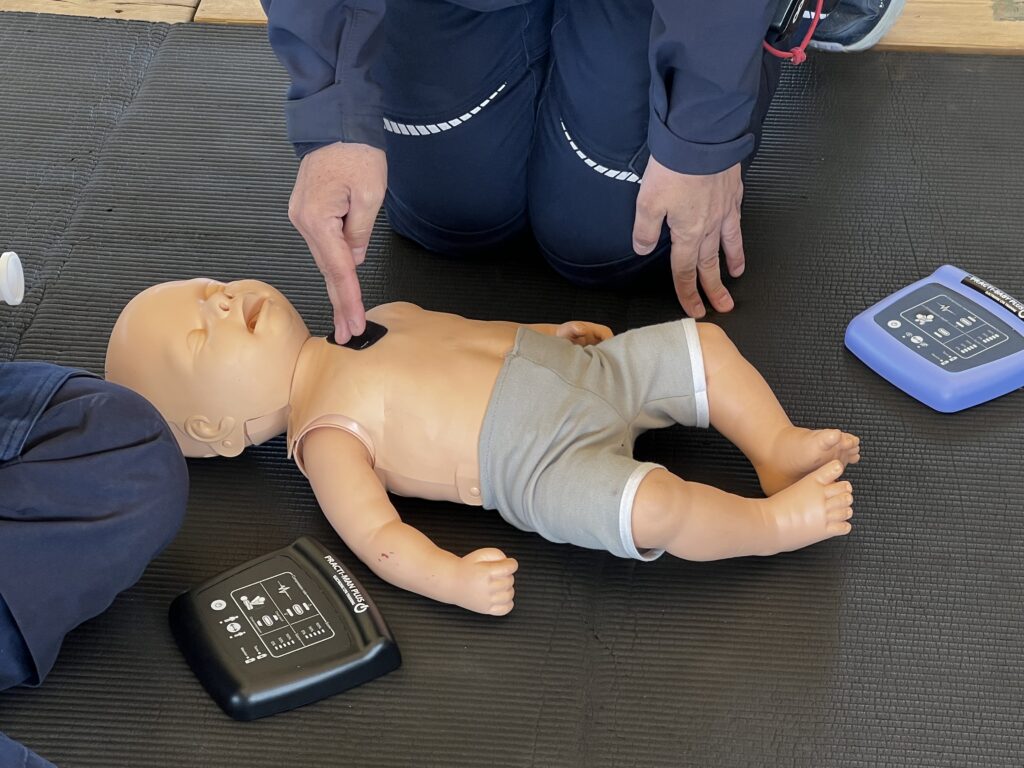
CPR training for children who may have survived at sea. The entire crew goes through them before every mission.Photo by Marta Abbà
Providing Care Under Pressure: What Can and Cannot Be Done
Clarisse works within that narrow margin. As the mental health specialist, her role is to provide initial psychological support—enough to stabilise, without reopening trauma.
“I help them identify strategies to cope with what they’ve been through,” she explains. “The goal is not to process everything, but to prevent the trauma from immediately solidifying into something more severe.”
“The goal is not to process everything, but to prevent the trauma from becoming something more severe.”
The challenge is finding the right space.
“The biggest difficulty is having a place where we can talk privately,” she says. “And we always have very little time.”
When possible, she holds one-on-one conversations or small group sessions in the shelter. But the ship is an open, shared, constantly moving environment. Privacy is relative.
With women, the work requires particular care.
“Many have experienced violence, but they are not always aware of it,” she explains. “Or they are, but they cannot talk about it at that moment.”
“We always have very little time.”
Opening that conversation carries responsibility: not leaving someone exposed without follow-up.
“We always have to ask what is best for them, here and now,” she adds. “Not what would be ideal in absolute terms.”
“We always have to ask what is best for them here and now.”
A significant part of the work on board is information—medical, legal, and practical.
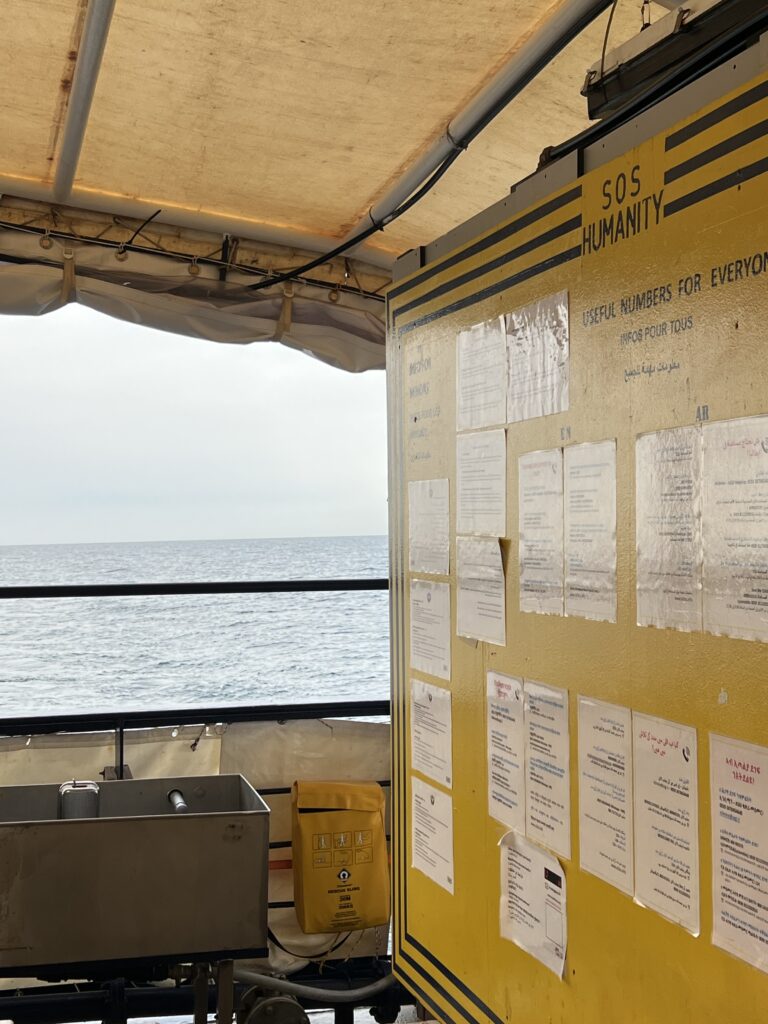
On the ship’s deck, a bulletin board with information in multiple languages about organisations and institutions to contact once ashore. Photo by Marta Abbà
Stefania organises sessions explaining what will happen after disembarkation: identification procedures, asylum applications, basic rights. “I’m not a lawyer, but we provide the information needed to navigate the system.”
“We try to give them the tools to make informed decisions.”
For women, this includes specific issues: access to gynecological care, psychological support, the possibility of terminating a pregnancy, services for survivors of violence.
“We try to give them the tools to make informed decisions,” Frances says.
But the boundary is clear.
“We don’t sell dreams,” Stefania emphasizes. “We also explain the difficulties.”
“We also explain the difficulties.”
Among the most complex vulnerabilities to address is trafficking and sexual exploitation.
“We know it exists in this context,” Frances says. “But it is very difficult to identify clearly on board.”
There are indicators: controlling dynamics, inconsistent stories, relationships of dependency. But turning these into formal identification requires time, trust, and continuity.
“If there is no system ready afterward, we risk doing more harm.”
“Addressing this too early can be traumatic,” Clarisse explains. “And if there is no system ready to take over afterward, we risk doing more harm.”
For this reason, the work focuses on essentials: raising awareness, providing information, and flagging potential cases to organisations on land.
It is, by definition, an incomplete intervention. But a necessary one.
After Disembarkation: The Gaps Women Face on Land
The transition from ship to land is abrupt. On board, the system is coordinated, concentrated, and focused on immediate care. On land, it fragments.
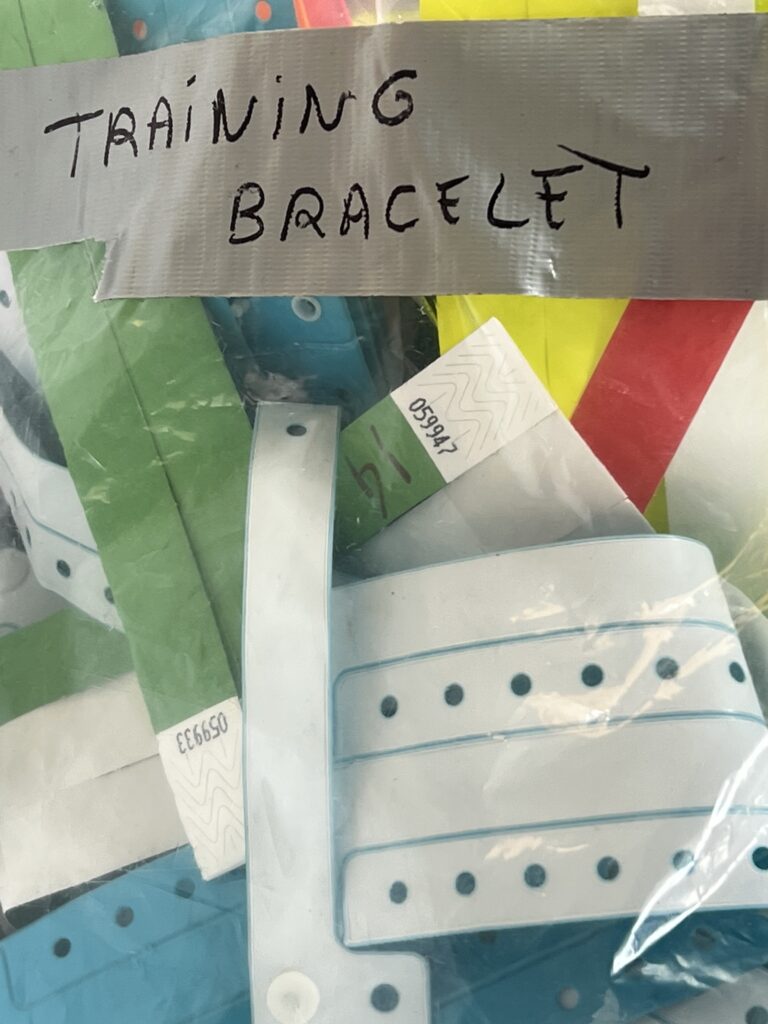
Bracelets. They are essential for identifying family groups immediately after survivors are rescued and ensuring they are not separated.Photo by Marta Abbà
“It depends a lot on the port,” Frances explains. “Each region has different organisations, different resources.”
Support networks exist—international organisations, NGOs, public services—but access is uneven.
“In general, assistance in port is less gender-focused and more broadly centered on vulnerability,” she observes.
“Assistance in port is less gender-focused and more broadly centered on vulnerability.”
For women, this can mean losing part of the specificity built on board.
“In some areas it is harder to find adequate services,” Clarisse says. “Especially for issues like gender-based violence or trafficking.”
The risk is that the work done at sea remains isolated.
Frances watches the system hold together. “We never know what we will find at sea,” she says. “But we know what we want to guarantee onboard: respect and access to dignified care.”
It is not an abstract statement. It is a daily practice, shaped by rapid decisions and constant trade-offs.
For the women on board, this translates into something concrete: a separate space, clear information, a chance to be heard. Not always complete, not always sufficient—but intentional.
“We know what we want to guarantee onboard: respect and access to dignified care.”
The shelter with the painted walls does not resolve anything. But it marks a point.
A point where, for a limited time, conditions shift. And from which, for some, something else may begin.
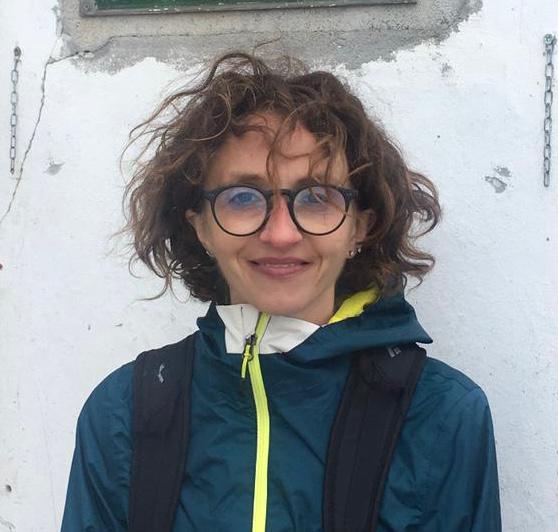
Marta Abbà is an Italian freelance investigative journalist and environmental physicist with a focus on climate and digital justice, gender and migrant rights.