Across Scotland, highly qualified migrant women are still being pushed into low-paid work, unpaid “experience-building”, and years of rejection. Their stories reveal the hidden barriers they face and what it really takes to secure a fair chance at work.
by Neha Thomas
In Scotland today, many migrant women still find it hard to get stable, fair work. They arrive with degrees, skills and work experience, but often end up in low-paid jobs, unpaid volunteering or long gaps in employment.
According to the Scottish Government, across Scotland, ethnic minority women are still less likely to be in paid work than white British women. This is despite years of equality strategies, such as the Race Equality Framework for Scotland (2016–2030) and the Race Equality Action Plan (2017–2021), alongside wider labour-market approaches aiming to improve work opportunities.
The ten migrant women living in Scotland who were interviewed for this article had similar stories to tell.

A woman looking at her computer worried. Photo on Unsplash.
Starting again
Many of the women interviewed described having to start again in Scotland, redoing steps to prove their skills and build local references, despite arriving with strong qualifications and work experience.
Anna came to the UK in 2009 with eight years’ experience as a doctor in India. “I had to wait 18 months before I could work as a doctor here,” she said.
During that period, she did unpaid voluntary work in hospitals to get UK experience and local references. She recalls: “I had to pass a two-part exam, an English test, and repeat medical exams, theory and practical, before I could even register with the GMC.”
Because she had no UK referees, she spent months shadowing consultants “until someone was willing to sign my competencies and write a reference.”
I had to wait 18 months before I could work as a doctor here.
Only after these steps could she apply for her first NHS job and then enter specialty training, which required further competency assessments to be signed off by supervisors. She is now a consultant in histopathology but says she would like to have more control over her time.
Una arrived in 2000 and found that her teaching degree from Mongolia was not recognised. She worked in charity shops, took extra training and went to 33 job interviews before she finally got a teaching post. She now works as a consultant, but feels that some of these employers only hire migrants to “tick a box” rather than to use their full skills.
According to Blam UK, 40% of Black African employees with A-level or degree-level qualifications are in roles below their skill level.
Nuru from Tanzania studied biomedical science in London before moving to Coventry and then Glasgow. She got a job in a laboratory and later moved into nursing. She feels it has not opened the doors she expected, especially after paying high international fees. Having to repeat an exam in Scotland meant she could not do her placements, which slowed her progress.

A woman sits at her computer, looking worried. Photo: Unsplash.
Mandeep, who came in 2020, was told that “the degrees I earned… they don’t work here.” She could not get work that matched her background and instead took a warehouse job during lockdown, then a care job through an agency. After a street accident in which she was hit by a car, her immigration case was sent to the Home Office and her right to work was frozen until at least 2026, leaving her unable to use her skills at all.
Visas, childcare and feeling stuck
In addition to visa rules, many of these women struggle to access work due to childcare costs and the lack of a local support network.
Close the Gap & One Parent Families Scotland point out that around 90% of single parents are women and that childcare is “vital social infrastructure” for their ability to take up jobs or increase their hours.
Evelyn’s visa changed from student status to Discretionary Leave after her baby was born, which only let her work for a set period and had to be renewed. Since she was alone, she had to rely on childcare providers she did not really know, which, she says, made her constantly worry about her children’s safety and made it hard for her to plan or move forward in her own career.
I wasn’t getting interviews and stayed in the same retail job for over ten years.
Christine, from Malawi, also moved from England to Scotland in 2009 under the Fresh Talent scheme that aimed to attract skilled workers. She says being a single mother meant she had to keep a retail job in order to keep her childcare support, abandoning her Master’s course.
“I wasn’t getting interviews and stayed in the same retail job for over ten years,” she says. “In England, opportunity felt like a door. In Scotland, it felt like a wall.”
Her employer’s policies spoke about diversity and inclusion, but she often felt undermined and that she had to prove herself “every single day, 100% more than Scottish colleagues”.
She says she did not make a formal complaint because she did not believe it would be understood or lead to change.
Aishah, an accountant from Nigeria, was told she needed to sit for ACCA exams to practice in the UK at the same level. With four children and a husband who became seriously ill soon after they arrived, she could not afford course fees or childcare.

A woman works at her computer, photographed from behind. Photo by Christina Wocintechchat on Unsplash
Racial Discrimination and the pull towards entrepreneurship
Racial discrimination was another shared experience among those women, who said this did not happen in a direct manner but was felt in remarks about their accents, in being judged as less capable, and in who is given opportunities to progress at work.
These experiences are common among ethnic minority workers according to a study by the Living Wage Foundation, which found that 56% of minority ethnic workers said they had been discriminated against at work, and more than a third believed they had been passed over for promotion because of their ethnicity.
Christine talks about being slowly worn down in a workplace that did not deal with everyday racism. She explains that in her current role “sometimes I feel like I’m giving too much, sometimes too little”, but that the problem is “very subtle… done in such a way where you can’t quantify it”.
Employers need to be educated about migrants, not just migrants educated about employers.
She feels that policies on equality exist only on paper: “Most of the policies are just there to cover the employers’ tracks. They’re not really being put into practice. Employers need to be educated about migrants, not just migrants educated about employers.”
Nuru also remembers white British colleagues changing the subject when they realised their negative comments about migrants might apply to her.
Chika, who has years of professional experience and has done national service in Nigeria, says the colleagues who made her feel most unwelcome were non-British white staff. “It’s not because I’m a woman,” she says. “It’s because I’m a woman from a different country.”
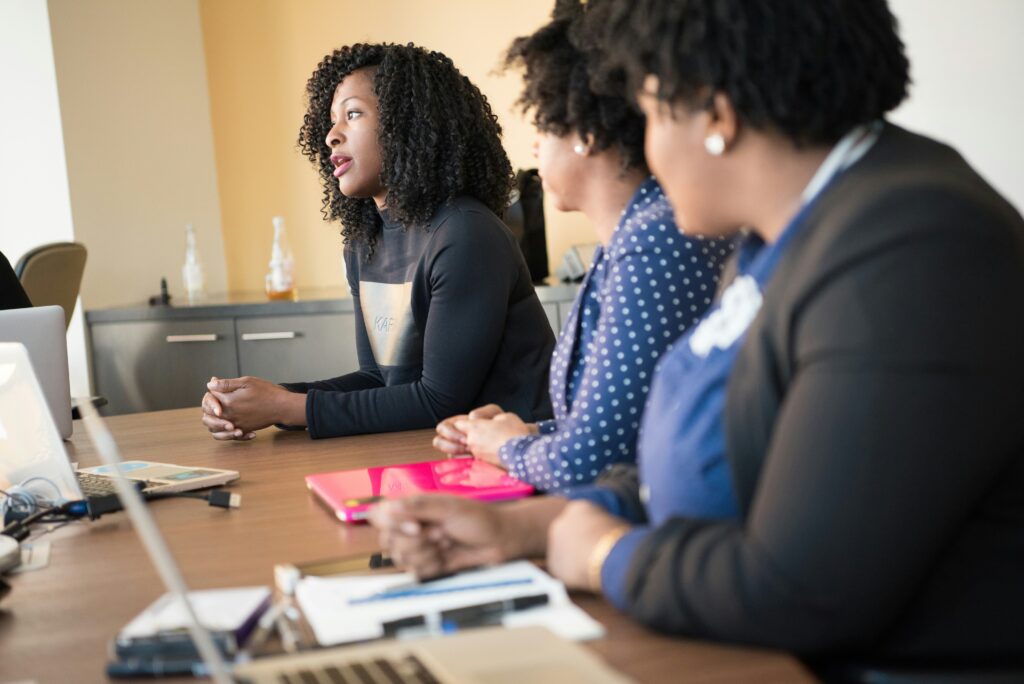
A group of women at work, discussing. Photo by Christina Wocintechchat on Unsplash
Not every story is the same
Teresa, an IT professional who moved from India to Singapore and then to the UK says she has not faced discrimination from Scottish neighbours or colleagues. Supervisors helped her understand how recruitment works and encouraged her to apply for roles that matched her skills.
Four of the ten women interviewed have lived and worked in both England and Scotland, and all four said it was easier to get work or move up in England. Their experiences sit within a wider Scottish pattern: an Equality Evidence Review by Skills Development Scotland reports that people from minority ethnic groups have an employment rate of 62% compared with 76% for white people in 2023, a gap of 13.8 percentage points.
For Tanzim, who has two Master’s degrees and corporate experience in India, five months of daily job applications in Scotland brought very little response.
I just want to say that the immigrants are helping in boosting your economy.
“You start questioning your background… Am I not even fit for the lightest job?” she says.
A female-led company in England hired her remotely, followed by a full-time job with a London-based firm where she feels recognised and supported.
Given all these challenges, many of the women are thinking about setting up their own businesses.
Una began her consultancy. Anna dreams of setting up a small business that gives her more time with her children. Chika wants to start a business too, though she imagines doing so somewhere other than Scotland.
Mandeep, who cannot work until her case is resolved, still hopes to open a small café for tourists in the hills once she is allowed.
“I just want to say that the immigrants are helping in boosting your economy,” she says.

A worried woman looking at a notepad. Photo on Unsplash
“Fair chances, not special treatment“
The women in this story are clear about what would help. Across their interviews, problems with childcare, recognition of overseas qualifications, employer practices and visa rules came up again and again.
Most have invested heavily in education. Many have taken unpaid voluntary roles to get “UK experience”. They work, study, raise children and support others in their communities, often without any family nearby.
There is already limited recognition of overseas qualifications in the UK system through UK ENIC, which compares overseas degrees and issues statements of comparability.
Whether from India, Malawi, Tanzania, Nigeria, or other countries, these ten women face similar challenges, from visa rules and childcare costs limiting their choices, to not having their degrees recognised. The majority had to settle for jobs they were overqualified for. Seven out of ten say they have faced discrimination at work or when looking for work and many want to start their own business to gain control over time and income. Those who have lived in both England and Scotland say it was easier to find a job, or progress, in England.
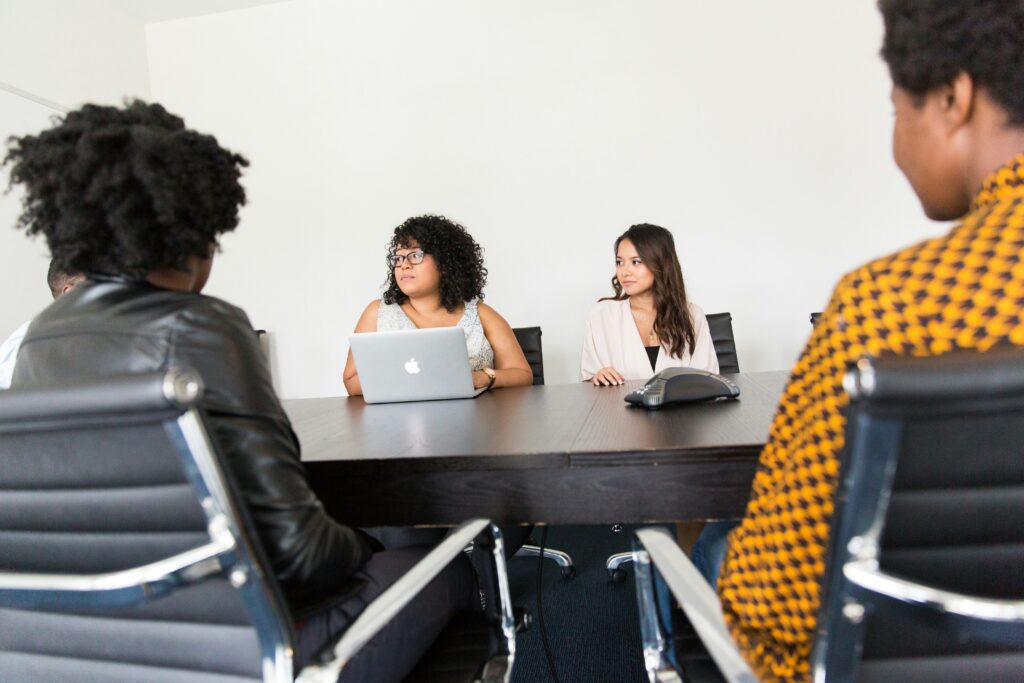
A group of women attending a meeting. Photo by Christina @ wocintechchat.com M on Unsplash
The Scottish Government has recently launched an Equality and Human Rights Mainstreaming Toolkit, aimed at helping organisations put equality commitments into everyday practice.
But such measures can sometimes lead to employers wanting to hire employees from ethnic minority backgrounds to meet diversity quotas, as Teresa pointed out in her interview.
She recalls being told that “the less you know, the younger you are, the better it is”, because managers fear that women who have degrees and past company experience will “go and manipulate them”, as in being accused of “playing office politics” simply for being confident and experienced.
She explains that this is why she left that job and instead applied for what she calls a more “fundamental” customer-service job, the kind focused on day-to-day enquiries rather than specialist work, which she got at the first attempt. Teresa and Mandeep said they felt that things would only change for women like them if employers and others really listened to what they were saying and took it seriously.
This article was produced as part of the Migrant Women Press Fellowship Programme 2025.
*Names have been changed and identifying details withheld to protect interviewees’ privacy.
Neha Thomas is a Glasgow-based postgraduate in Media and Communication, with a background in Human Resources and storytelling. Passionate about journalism, migration, social impact, health, and creative writing, she combines research, writing, and advocacy to amplify the voices of underrepresented communities.