Writer Jinling Wu traces the personal stories of women who have migrated for love, exploring how they navigate belonging and the work of building new lives far from home.
by Jinling Wu
Migration didn’t begin for me with a grand plan or ambition. My partner, a European academic who received offers from both Chinese and UK universities, opted for working in Edinburgh because it felt familiar for him. I quit a corporate PR job in Shanghai I had a lukewarm interest in and followed.
At the time, I didn’t think of it as migration at all. It felt like a gap year — a small detour I could take without consequence. Only later did I understand that this detour had quietly rewritten the map of my life.
I began asking myself what I had actually stepped into. Was this migration, love, or something more complicated? When I realised how little I understood about my own choices, I turned to other women. I wanted to know: what does it mean to relocate for love? What do we lose, negotiate, reshape in ourselves? And do we ever fully arrive? These questions quietly pressed against my life, and the interviews became my way of answering them.

Beijing, China. Photo by Yuhan Wang on Unsplash
Grace: The Math of Hope
Grace* was the first to respond. A former head of data and insight for a major tech company in Beijing, she was in her thirties and feeling growing pressure — from both family and society — to marry.
Originally from Shanxi, she had moved through several cities in China for her education before eventually settling in Beijing. But as the new internet economy surged, her workplace began to feel like a polished supply chain of modern-day slavery — one that demanded relentless productivity and left little margin for well-being. There was barely any space to build meaningful connections.
Using her professional instincts, she calculated the probability of meeting a compatible partner in Beijing versus abroad. The numbers nudged her toward leaving. The long pandemic lockdowns pushed her further. She applied to study Psychology at the University of Glasgow. Six months after arriving, she met her current partner on a dating app — a Glaswegian who also works in IT, whose knowledge of K-drama still surprises her.
While studying, Grace began therapy to work through old trauma she had never had time to face. After more than twenty sessions, she felt steadier — ready to step out of isolation and look for friendship and opportunity. She is now searching for roles across the UK. She admitted that the head of data and insight position requires extensive cross-department communication and a high level of English proficiency, which she feels she hasn’t yet reached. She is willing to take a junior position if necessary.
Even with reduced professional capital, she remains firm in her decision. She appreciates the kindness she has found in her new environment and the broader culture’s respect for individuality. Her anxiety has eased considerably, and living with her partner has given her a greater sense of home.
“I left a toxic work environment and a difficult family situation,” she said. “I’m living in the moment now, and I’m proud of the freedom I’ve earned to be myself.”
When I asked about the current wave of anti-immigration sentiment, she said she wasn’t too worried. But in her eyes, I sensed a flicker of doubt — slight but unmissable.
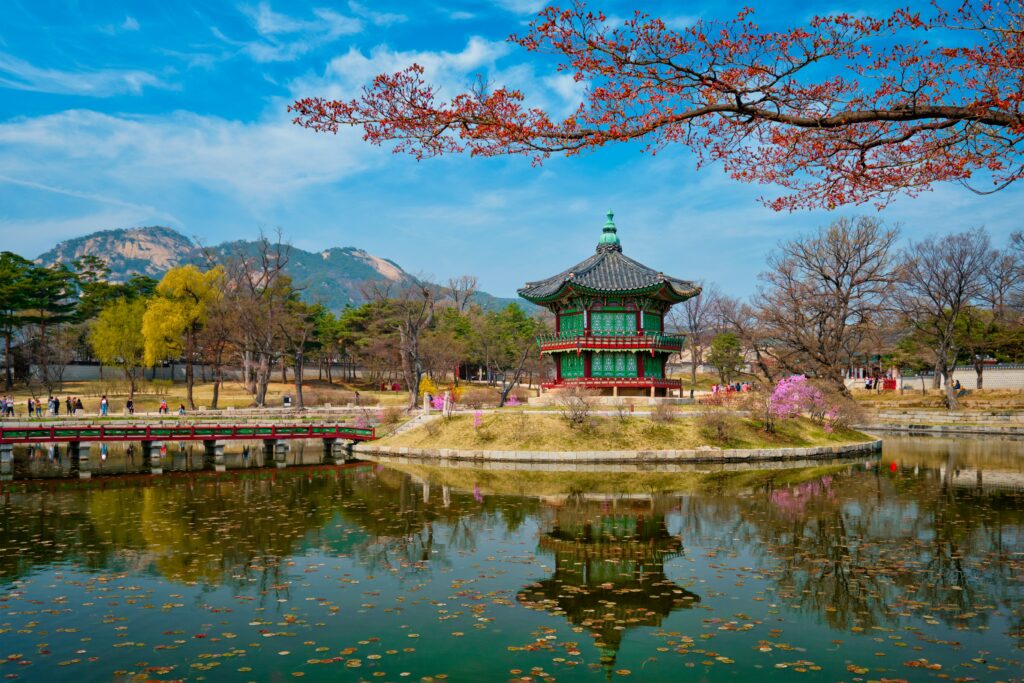
Hyangwonjeong Pavilion (향원정) in Gyeongbokgung Palace, Seoul on Unsplash
Kim: The Geography of Love
I met Kim* two years ago in a Japanese language club. She mentioned once that she had lived in Japan because of her husband’s work. The club dissolved, but we reunited this year at a series of Japanese literature events. Over bowls of pho, she told me how, in her twenties, she made a bold plan in Seoul and flew to London to meet her boyfriend — now her husband of nearly three decades. I knew I wanted to hear more about her story.
Kim was born in the late 1960s in the United States to Korean parents. When she was four, the family returned to Seoul. Later, her father’s work took them to the Philippines. In the new international school, her English wasn’t fluent enough at first to show her personality — to make a joke or assert her opinion — but that changed over time. She said that brief period made her empathise with outsiders.
Back in Seoul, Kim studied English Literature and became the first in her department to land a job at a major international company. She met her future husband, a young British colleague at the company. They had been together for a year and a half – all the while working at the same firm – when he was called back to London. Around the same time, her company hinted at layoffs and asked whether she planned to marry.

Cityscape in Seoul, South Korea around sunset. Photo by Mathew Schwartz on Unsplash
By then, Kim’s parents had already met her boyfriend and liked him. Kim and her boyfriend wanted to spend more time together without rushing into marriage. They agreed to try living together for six months in London. But Kim knew her parents would never allow their unmarried daughter to live with a man, even one they already liked. So she told them he had proposed, explaining that the wedding preparations would take six months — giving her time to test whether life together in the UK would change their relationship. She quit her job and took the risk, convinced he was the one, and confident she could find work if things fell apart. In the end, he proposed just three weeks after she arrived.
After the marriage, she found a job at Samsung’s European headquarter in London. When the headquarter closed during the 1998 Asian financial crisis, she landed a coveted role at an elite advertising agency, competing with hundreds of candidates. When she was five months pregnant, her husband was relocated to Japan. She quit her job again and followed him. In Japan, she gave birth to two children. Because she entered the country on a spouse visa, she was not permitted to work, and she soon found the situation increasingly insufferable.
After negotiations with her husband, the family relocated to Thailand, where she worked as a regional account director for Southeast Asia. She greatly appreciated the domestic help she received there. Yet the fact that she only saw her children on weekends — when she was already exhausted from work — prompted the move back to London, where she stopped working to focus on her family, a choice she never regretted.
When the children grew up, Kim and her husband retired early to Edinburgh for its walking trails and quiet rhythm.
“There were challenges, of course — the kind you expect when you move from a place you’ve just settled. But I always believed I could adapt. I’ve done it many times.”
When I asked about discrimination, she recalled one incident from her first week at work: a white colleague simply announced that it was Kim’s job to clear away the tea after a meeting. Kim reported it, and though the colleague was dismissed a week later, she isn’t certain the two events were directly connected. Aside from that, she said she hadn’t faced explicit racism in her workplaces.
I then asked what she might tell her twenty-five-year-old self, she grew emotional. “I was excited,” she said, “about starting a new chapter with someone I truly loved. I was so in love that I didn’t realise how hard it would be to live far from my parents, my sister, my friends. I just didn’t think that deeply about it then.” Her mother passed away two years ago.
As our conversation drew to a close, I asked what she wished people would ask her, she said, “There were challenges, of course — the kind you expect when you move from a place you’ve just settled. But I always believed I could adapt. I’ve done it many times.”

Open notebooks with handwritten notes, a pencil and pen on the pages. Photo on Unsplash
My Story: Becoming in a New Language
Both Grace and Kim had a very positive opinion about their own decisions and about immigration in general. Their self-validation was also evident. But to me, when I started working on this project, the quest came out of doubts rather than affirmation. I have moved a lot growing up. I was born in a small town in China. Growing up, every time I advanced in my study, I moved; first to the cities, then to the megacity Shanghai.
Later, in order to complete my two separate masters studies, I lived in Austria, Czech Republic, Portugal, Estonia and the UK. Out of my personal curiosities, I also traveled around the world. To me, every place would leave memorable impressions. Yet my sense of belonging was undermined. In a way, I don’t belong to my home country anymore. But I also don’t belong to all the places I have lived or am living in.
I was trained in journalism and worked as a reporter and then in PR before leaving China. With a “gap year” sort of idea, I enrolled in a film school. I stumbled through film school, but the filmmaking process forced me to face my own reality. It taught me to hold difficult emotions instead of evading them.
I soon realised I was in a very different market, and that my skills — combined with my identity — were not easily valued. There were grittier, more pragmatic ways to survive, but I decided to give my dream a chance.
Unlike my university graduation in Shanghai, where I had been one of the most sought-after graduates, completing my studies in Europe left me navigating the gritty reality of finding work in an unfamiliar landscape. I soon realised I was in a very different market, and that my skills — combined with my identity — were not easily valued. There were grittier, more pragmatic ways to survive, but I decided to give my dream a chance.
I was publishing essays from a young age and won writing prizes in high school. During university, I freelanced for magazines to support myself. In Shanghai’s hyper-commercial environment, I wrote plays, short stories, and reviews of theatre and art on the side, yet I couldn’t see a realistic path to becoming a full-time writer — one who could afford to say no to more useful kinds of writing.
Yet in Edinburgh, when I finally gathered courage to pick up a pen and write my own story, I found a dilemma that belonged to writers who have migrated. Every time it came to name a character, I dreaded them. I did not feel comfortable commanding English names because I did not grow up with Emma and Catherine. Then I was afraid of using Chinese names. Because when I wrote Chinese names in English, it drew out stereotypical impressions that had nothing to do with the essence of the character. I wrote a little poem about this awkward feeling:
I refuse
to name my character.

In a story, once a Chinese name
is inserted
into an English text
I have to explain
where he comes from.

I have to walk him in a Chinese supermarket,
appoint an acupuncturist to treat his ailment,
name a cousin who was suspected to know something about Kung Fu.

But does any of those things
matter

when he walks
into his own darkness
at night.

Writing desk with a laptop, coffee, handwritten notes, and a phone. Photo by Andrew Neel on Unsplash
In the end I chose an abstract way to name them J, K, or H. This Kafkaesque manoeuvre inspiration didn’t come from Kafka. It simply came out itself when I had to name my character and I fought, stuck and then decided to ease the tension by going abstract. In a way it also suited my writing. For me human conditions are similar everywhere. Our differences in language, custom and habits are cute peculiarities out of the ubiquitous indifference and cruelty.
Some people make the transition more smoothly, and not every artist struggles. But I don’t mind admitting I’m in that stage — learning to be productive in a new arena, and to find existence in the struggle itself.
Migration, I’ve learned, is not a line on a map. It is a chronic condition of the heart. You learn to manage the flare-ups of loneliness and the dull, persistent throb of nostalgia. The stories of migrant women are so often written in the passive voice. But to listen to Grace and Kim is to understand the active, relentless verb this life requires. It is choosing, building, managing, enduring, creating. And you do it not for fame or ambition, but for the most ordinary and extraordinary reason: for the chance to be yourself.
*Partial names and identifying details have been withheld to protect the privacy of interviewees.
This article was produced as part of the Migrant Women Press Fellowship Programme 2025.

Jinling Wu is a writer based in Edinburgh whose work spans fiction, non-fiction, theatre, and film.