For many Africans in the UK, paying their own bills is only half the story. They’re also burdened with the responsibility of financially supporting relatives back home. How does culture and history shape these pressures and impact African families?
by By Christiana Opoku
Akua Adwubi opens the door to her three-bedroom council flat in Glasgow. She’s just returned home from a nine-hour cleaning shift at Tesco. Right away, she notices a letter laying on the hallway carpet. Another one from the gas company.
Just as Akua kicks her shoes off, her mobile phone rings. Her mother is calling for the fourth time in 24 hours and Akua already knows why. It’s the end of the month so Akua needs to send money to cover living expenses for relatives in Ghana.
Meanwhile, Akua, a single mother-of-four, wonders how she and her family will survive until the end of the month. Once she pays her bills — and her mother — she’ll have £100 left until her next pay day.
This is the reality of many Africans living in the diaspora today. While dealing with the economic pressures in the country they find themselves in, they must navigate these with a cultural lens — and culture carries its own values and morals. One of these is providing financial support to family, so as well as paying income tax, just like Akua, many people find themselves paying the ‘Black tax’ too.
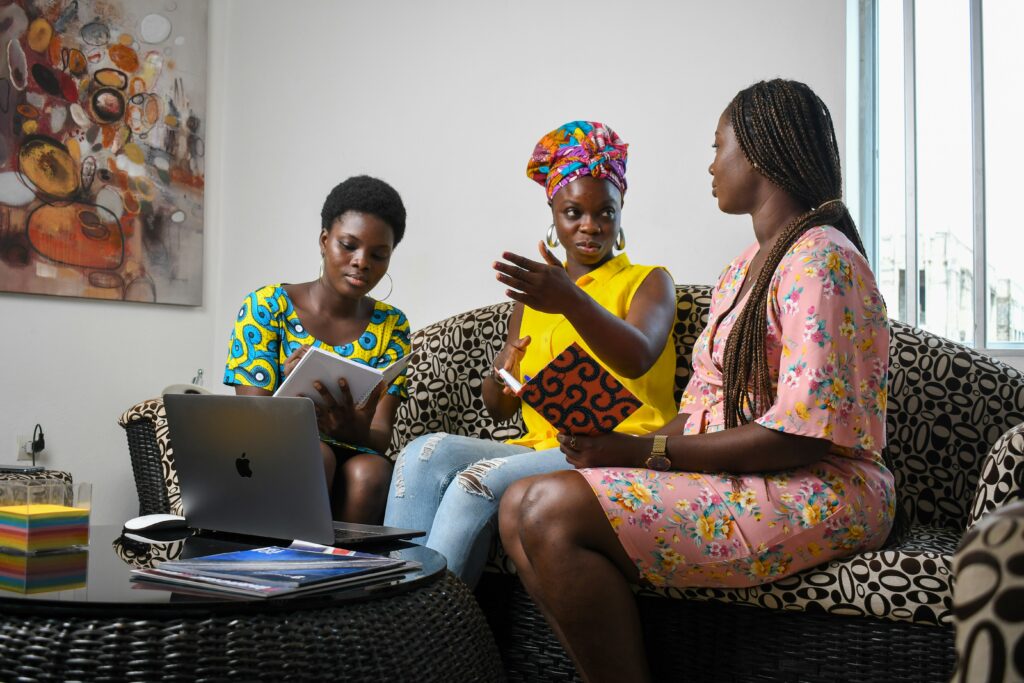
African women planning their future in a meeting. Photo by Iwaria Inc. on Unsplash
According to a study by the University of Pretoria in South Africa, where the phrase originated, the Black tax refers to family financial support obligations linking the emerging Black middle class to poorer relatives, usually living ‘back home’. However, long before the term was forged, Black families treated migration as a family economic project, Dr Freda Owusu-Sekyere explained.
The former banker, who works as a research consultant in cultural heritage, has studied remittances from Ghanaian and Nigerian senders living in Britain.
“[When] there isn’t a strong welfare or social protection system in their countries, the remittances that are sent are a form of private social protection,” Dr Freda said. “These are used for medical and educational bills, among others.”
The requests for money also reinforce a form of transnational living, Dr Freda added, which refers to a way of life where individuals maintain socio-economic connections across national borders.
“When you’re a migrant, there’s often a lot of fear of ‘What if things don’t work out here?’ So, you find that people here live in preparation of going back home.”
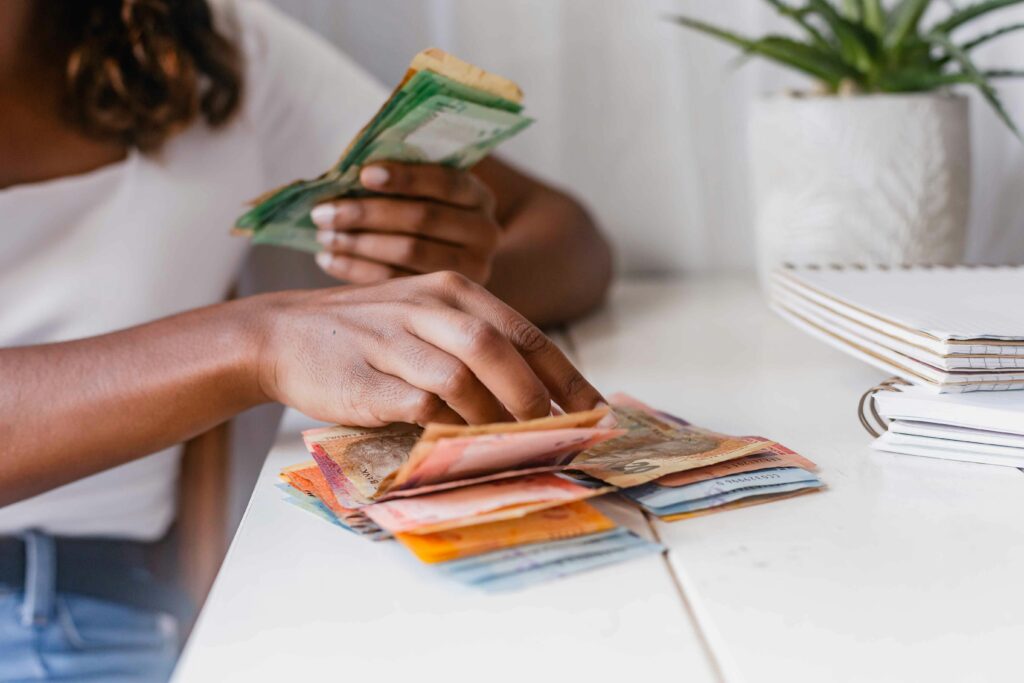
A Black woman counts banknotes on Unsplash
Therefore, it’s seldom the plan of an African migrant to settle permanently in the new country, but rather to take advantage of greener pastures to boost their family’s life chances – both the one with them and left behind – support their community back home and create an ideal home they can return to. This is often their retirement plan.
The Financial Reality for African Migrants
“I travelled abroad as a foreigner,” Akua said. “My mum and relatives are in my motherland. When all my children are married and away, I don’t want to be old and alone. I want to go back and have a home.”
Akua has never regarded any other country as “home” despite having left Ghana more than 25 years ago for Italy and then for Scotland. This is why she’s been building both a house and a business in Ghana. For many African migrants, sending money home isn’t just an economic transaction but is regarded as evidence of their success.
According to the Migration Observatory’s 2025 briefing, which uses data from the World Bank, migrants in the UK sent about £9.3 billion in remittances to family and communities abroad in 2023. Nigeria is among the top three destination countries overall and African states, such as Somalia and The Gambia, are among the most dependent on remittances from the UK.
Poverty is a key reason for this reliance on family aid. An estimated 468 million Africans are living in extreme poverty, a report by the Economic Commission for Africa highlighted in March last year. In these circumstances, paying for a passport or plane ticket to relocate for work abroad is near impossible.
“I’ve been supporting my family back home for almost three decades. I never stopped, even when I had children or was unemployed.” Akua Adwubi
Meanwhile, UK visa and immigration rules are getting stricter, restricting people’s ability to earn more money here, which is likely to increase demand for remittances. Life in another country isn’t as promising as it used to be to the families of many migrants, so they decide to remain put and rely heavily on the financial support of relatives in the diaspora. Akua’s brother was rejected multiple times for a Ghanaian passport, which would allow him to travel to the UK. When she managed to leave, she instantly became a beacon of hope and survival.
“I’ve been supporting my family back home for almost three decades,” Akua revealed. “I never stopped, even when I had children or was unemployed.”
What relatives back home aren’t aware of is the financial gap between ethnic minorities and their Caucasian counterparts, adding to the financial hardship of those living in the UK. The Office for National Statistics (ONS) found that between 2012 and 2022, Black employees were the only ethnic group to consistently earn less per hour than White employees.
Building Change Through Financial Education
Money coach Tynah Matembe, founder of MoneyMatiX, a FinTech company providing financial education to individuals and communities across Scotland, said this widening gap is influenced by two major factors: lack of financial literacy and financial educators.

Tynah Matembe is a financial educator based in Scotland. Photo supplied by MoneyMatiX
She said: “The rules of play in the UK are different from the rules of play elsewhere in Africa. There’s not been any structural way for educating migrants on money.
“And there’s a small percentage of people who are talking and writing about it.”
Tynah, originally from Uganda, has been in the UK for more than 17 years. Moving from a cash-reliant economy to a new country, where the economy is especially dependent on credit history, made Tynah financially vulnerable.
“[As] I didn’t want my children to go through the same situation, I suddenly wanted to educate myself and be financially well off. I became obsessed and turned into a wealth seeker,” she laughed.
Tynah wishes to equip other migrants with financial knowledge so they can make better choices. Her book, Conquering Your Financial Giants, provides a roadmap to financial freedom and addresses issues such as debt management, budgeting and investment strategies.
“[As] I didn’t want my children to go through the same situation, I suddenly wanted to educate myself and be financially well off. I became obsessed and turned into a wealth seeker” Tynah Matembe
Without financial literacy, migrants cannot build wealth for themselves and therefore cannot comfortably support their family back home. Many will lie to relatives about their financial wellbeing to protect their reputation or avoid concern, while also dealing with mental health issues linked to money pressures.
Those that often find themselves in this position are first-generation migrants like Akua, who are loyal to cultural obligations. But as they create families of their own abroad, their children also end up living through the sacrifices being made at home. For Isabelle Gampine, also Akua’s daughter-in-law, this bred resentment.
Isabelle, 27, remembers having to wear secondhand clothes as a child while her dad, a manual labourer, supported several relatives in Burkina Faso, West Africa.
She said: “Growing up, I saw my father working and sending money. At the same time, we might need something at home, but he wouldn’t spend money on us. That was very disturbing for me.”
Her husband, Justice, 32, has a similar experience. But over the years, he realised it wasn’t entirely his parents’ fault.
“Once I grew up and started working, I saw that if [family] ask you for money and you send it, they will keep asking, so I reached a point where I had to say no. I send money but not every time they ask for it. Too much is too much.”

Families should have honest conversations about finances. Photo by Christina @ wocintechchat.com on Unsplash
For African diasporans in the UK, culture and history shape their spending habits, discussions on wealth building and financial priorities in intergenerational families. Money is more than paper: it commands respect, protects status and sustains identity.
The Black tax isn’t a failure of personal discipline but the result of global inequality, weak welfare systems ‘back home’, racial pay gaps and the inherited expectation of sacrifice amongst immigrants. Remittances act as private social protection, but they cannot replace functioning public systems indefinitely.
Meaningful change must be collective. Investment in African social infrastructure would reduce reliance on diaspora income, while tackling pay inequality and expanding culturally-relevant financial education in the UK would empower migrants to build wealth sustainably.
Within families, honest conversations and boundaries are essential. Supporting relatives shouldn’t require erasing one’s own future or that of the next generation, but should mean offering help within healthy limits without sacrificing stability, dignity, or long-term wellbeing.
This article was produced as part of the Migrant Women Press Fellowship Programme 2025.

Christiana Opoku is a first-class creative and journalist who turns ideas into impact, shaping bold narratives across print, digital, and audio-visual platforms. From filming and editing to page design and social content, she leads the creative process end-to-end. She currently works as a sub-editor on the world’s longest-running women’s magazine and drives projects from concept to print. Reach out to her at christyopoku3453@gmail.com.